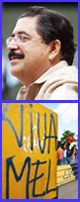
02 de agosto 2009. - El Frente Revolucionario de Cantores Lloviznando Cantos crearon dos canciones nuevas para apoyar a Manuel Zelaya y denunciar el golpe de estado en Honduras.
lunes, 3 de agosto de 2009
(AUDIO) Dos canciones de Lloviznando Cantos para Honduras
Micheletti expresa su "respeto y admiración" por la policía y ejército golpistas
Su satisfacción con el trabajo represivo de la policía y el ejército lo manifiesta un día después del asesinato de un maestro en extrañas circunstancias, en un crimen que seguidores de Zelaya atribuyen a la policía / Sostiene que su gobierno no prohibirá la libre circulación, ni echará gas si hay acción pacífica
(VTV)
El gobernante de facto de la República de Honduras Roberto Micheletti, expresó su "respeto y admiración" hacia los funcionarios policiales y el ejército golpista, quienes a su juicio han tenido un "permanente diálogo" con las organizaciones populares que defienden el retorno del único presidente de la nación centroamericana, Manuel Zelaya.
Estas declaraciones las ofreció antes de su viaje a la población de San Pedro Sula para tratar de buscar un acercamiento con los seguidores de Zelaya y evitar la prolongación de protestas que exigen el regreso del orden constitucional.
Su satisfacción con el trabajo represivo realizado por las autoridades policiales y miembros del ejército lo manifiesta un día después del asesinato del maestro Martín Florencio Rivera, ocurrido en extrañas circunstancias; un crimen que los opositores al golpe de Estado del 28 de junio atribuyen a la policía.
Así también tras la muerte de otro docente de nombre Roger Abraham Vallejo, quien fue impactado por una bala en el cráneo el jueves pasado, cuando funcionarios militares y policiales, reprimieron una marcha pacífica.
Esto, sumado a la muerte del militante Pedro Magdiel Muñoz, quien sería encontrado el 25 de julio en la población de El Paraíso cerca de la frontera con Nicaragua, donde simpatizantes del presidente Zelaya habían acudido para apoyar el intento de regreso de su mandatario constitucional.
Además del vil asesinato de Isis Obed Murillo Mencia, joven de 19 años, quien fue asesinado el domingo 5 de julio, mientras se realizaba una protesta pacífica en espera del presidente Zelaya en las afueras del Aeropuerto de Toncontín.
Sin contar las acciones violentas que con disparos, gases lacrimógenos, y el uso de camiones antimotines que utiliza la policía y el ejército de facto contra el pueblo hondureño que en 36 días han exigido de forma pacífica mediante caminatas y consignas el regreso de Zelaya.
Todo ello ocurre en un ambiente de permanente asedio contra los medios de comunicación del país centroamericano y prensa internacional.
No conforme con esto, Micheletti manifestó su preocupación ante lo que cree que se está prestando Nicaragua desde la zona fronteriza con "grupos dizque armados para venir atacar a Honduras", agregó.
"En este país nadie va a prohibir la circulación de los ciudadanos en ninguna parte, nosotros no vamos a echar gas a nadie, no vamos a golpear a nadie si hay acción pacífica de parte de los señores que están haciendo las tomas".
Sobre el paro general apoyado por los sectores socioeconómicos de ese país y el bloqueo de las principales carreteras, dijo que "no es justo que la economía del país se debilite por un pequeño grupo de manifestantes", al tiempo que llamó a los educadores con "todo aprecio" a incorporarse en sus funciones.
Indicó que supuestamente posee videos de personas que protestaban contra Zelaya y que ahora lo hacen en su gestión.
En lo que denominó como una "mentira y una falsedad" la denuncia de las permanentes represiones y el bloqueo contra la prensa local, dijo que lo "queremos que aquí se transmita es la paz y la tranquilidad que realmente hay en el país", concluyó.
Fuente: www.vtv.gob.ve
.
Dos maestros asesinados en tres días
Giorgio TrucchiFuente: www.alainet.org
.
A Chance for Real Democracy in Honduras
Julyn 29, 2009 "Information Clearing House" -- -Honduras is changing. In 1981, Ronald Reagan imposed democracy from the outside, yielding a constitution that minimized the participation of the citizenry in the decisions of their government and a process that repressed and decapitated the social movements—led by workers, peasants, and students—who sought to have their voices heard. Nearly three decades later, as President Manuel Zelaya made marginal steps toward reform, by raising the minimum wage from about $0.50/hour to about $1.20/hour and attempting to create a mechanism for the people’s participation in their government, the previously fragmented Honduran elite united to overthrow him.
That same elite and a deeply colonized Honduran middle class thought that the United States and other conservative members of the international community would embrace this undemocratic step. That was their first miscalculation. Their second misstep was to assume that the historically acquiescent Honduran people would shut up and accept the dictates of their social and economic superiors. The complete opposite has turned out to be true.
Huge masses of Hondurans are responding with outrage and indignation, refusing to accept the lies of the coup leaders and their propagandists. With cowboy hats and varied skin tones, they have marched. With music, theater, and banana chips, they have protected the few journalists and media outlets that have remained independent in spite of the threats and intimidation. For example, Natalie Roque, a young historian in charge of the National Newspaper Archive, scanned old newspapers and posted them on Facebook for her friends to learn about Roberto Micheletti’s attempt to convoke a Constituent Assembly—the very crime that he accuses Zelaya of—back in 1985; that Cardinal Oscar Andrés Rodríguez has been receiving a monthly allowance of $5,000 from the Honduran government since 2001; and that military chief Romeo Vásquez Velásquez was convicted of leading a group of car thieves in February 1993. After releasing several embarrassing moments in the coup leaders’ past, including the time when Micheletti was arrested for ripping off passengers on his buses, she was fired. And when internationally renowned cartoonist Allan McDonald was arrested after protesting the coup, cartoonists from around the world rallied in support, satirizing in their local papers the undemocratic transfer of power that had taken place in Honduras.
When the coup government cut the power of the poor rural communities of southern Honduras, the campesinos (peasants) tuned in their AM radios to broadcasts from Nicaragua and El Salvador, getting around the Honduran media’s assault of soap operas, old soccer games, and sermons about the “peace” and “democracy.” Or, when agents from the police Criminal Investigation Unit (DNIC) photographed demonstrators from an unmarked car, the demonstrators stopped the car and pulled out their own digital cameras to photograph the effort to intimidate them. Photography can be used as a means of domination and a way to naturalize socially constructed inequalities, but it is also being used here to document repression, making visible what the coup government would like to hide from the world.We are witnessing a democratic awakening of the Honduran people. This time, if democracy is restored, it will come from the bottom up, from university students camped out in stairways to protect journalists, from workers with cheap digital cameras, from campesinos hiking through mountains and flouting curfew to say to elites: “Hello! This is not how a democracy conducts itself.”
The new liberal Honduran political culture that is being fashioned at this moment is not emerging from empty space. Its elements were there from the beginning. From 1837-1849, following independence from Spain, the indigenous Lencan of Texiguat fought in Francisco Morazán’s army for a united Central American Federation of States. In 1954, as workers and artisans, women and men, refused to load bananas onto boats now owned by the Chiquita and Dole Fruit companies, a new Honduran political subject was brought into being. In the 1970s, as campesinos struggled for land reform and dignity, a vision of Honduran democracy was being formulated. This vision was not of unlimited freedom for the few and a mockery of the principle of equality for the many. Instead, campesinos were insisting that freedom and equality could not be brutalized by the elite and their U.S. backers. And now, in 2009, after a military coup orchestrated by the commercial elite, blessed by the leaders of Honduras’s evangelical churches and the hierarchy of the Catholic Church, embraced by much of Honduras’s small middle class, and only tepidly denounced by the United States, the ghosts of the indigenous of Texiguat, the banana plantation workers of El Progreso, and the campesinos of Tocoa, are coming back to haunt the present moment.
If the Honduran people manage to oust the coup regime and to reinstitute their democratically elected president, this will be the moment when Honduran democracy is born. But this time, the people are fighting not for plutocracy hidden behind a fig leaf of “democracy,” but for a system of government that is of, for, and by the people.
But this is not a struggle easily won. The elite and its coup government have their guns pointed at those who oppose them. Curfews are being imposed throughout the country, restricting people’s ability to move freely within their own country. Nonviolent demonstrators against the undemocratic regime are being beaten up, intimidated, and in some cases killed. On July 2, journalist Gabriel Fino Noriega was first threatened for having reported on the popular resistance to the coup; then he was gunned down. On July 11, Roger Iván Bados González, a member of the leftist party of Democratic Unification (UD) was executed in his own house by a group of ununiformed men. One day later, another leader from the UD, Ramón Garcías, was returning from a demonstration against the coup when he was kidnapped from a bus and then killed. On July 5, I heard the gunshots that took the life of nineteen-year-old Isis Obed Murillo Mencías. I photographed the pool of blood that he left behind. And when a Honduran newspaper, La Prensa, published a photo of Murillo Mencías being carried away, they airbrushed out the fountain of blood that poured from the back of his head; but in a public sphere that is now international in scope, viewers in other parts of the world saw the life dripping from the boy’s head. Each day, the killings, physical and symbolic, continue.
In Honduras, the rightwing has kept the masses of poor people at bay not through indiscriminate killing but through carefully targeted repression designed to decapitate social movements. Throughout the late Cold War, elite squads in the Honduran military, with direct assistance from the United States, gathered intelligence and tracked down leaders of groups clamoring for justice and systematically eliminated them. This surgical repression often fails to spark the moral outrage of the international community and allows the Honduran elite to continue ruling the country with little regard for the poor and less regard for the country’s democratic institutions.
As the ghosts of those fallen in the long struggle for a more just Honduras come back to haunt the present moment, the Honduran elite must be worried that this time they may have overplayed their hand. As defenders of the coup invoke Gandhi, M.L.K., and Israel in their piously absurd attempt to hold on to power, they increasing sound like cartoons themselves. This time the Honduran people are not so easily bullied. This time they are not accepting the emaciated and exclusionary form of “democracy” that they are being offered by the Micheletti regime. This time they are demanding not only the restitution of their elected leader but a participatory democracy that responds with concrete action to their long forgotten plight.
But in the all-too-likely scenario that the coup government is able to hold out till the elections in November, the social wound inflicted on the Honduran body politic will only grow deeper. The main candidates—Elvin Santos and Pepe Lobo—will go forward with their campaigns, attempting to “put the coup behind them” as they seek the legitimacy of elections. Meanwhile, the current government will continue its acts of targeted repression, quelling dissent, and disarticulating the broad opposition movement that is congealing around the demand to restore democratic rule in Honduras. This unexpected opening in Honduran political culture will be nailed shut.
Yet hopefully, this time, at this defining moment, the United States will be on the side of the poor Hondurans struggling for a democracy based on principles of liberty and equality. This could give substance to President Obama’s pledge to forge a new relationship with Latin America.
Kevin Coleman, a doctoral candidate in Latin American history at Indiana University, is conducting field research in Honduras. He previously authored the HNN piece: “A Coup is Not a Coup. A Not Coup is a Coup.”
This article was first published at the History News Network
Fuente: www.informationclearinghouse.info
.
Enloquecidos fanáticos fundamentalistas y charlatanes en Miami en campañana manipuladora en favor del GOLPE!
Fuente: Este material visual se encuentra en el portal del usuario de Youtube "DiestraEnAlto" Como usted puede ver el nombre hace referencia al saludo Nazi, es un portal Nazi y distribuye material de extrema derecha fascista. Contiene además información sobre toda una red de organizaciones golpistas. Si se hace una asociación de dicha red se evidencia el carácter fascista de quienes promueven el golpe de Estado y sus vinculaciones seriamente dudosas.
El contenido de las imagenes es una clara muestra de la incapacidad que tiene Vásquez Velasquez para fungir como jefe de fuerza armada alguna. Es realmente preocupante!
El Colectivo Honduras en Lucha se distancia de la fuente y denuncia la gravedad de que este tipo de campañas se desarrollen sin consecuencia legal alguna.
Llamamos a reproducir el llamado a denuciar este tipo de maniobras obscuras y a divulgar este tipo de vinculo entre promotores del golpe de Estado en Honduras.
.
Is a Wider Right Wing Counter-Attack Looming?
The Honduran Coup as Overture
By MICHAEL FOX
On Tuesday, July 28 the United States government announced that it had revoked the visas of four leading members of the Honduran coup. More than a month after the Honduran military awoke President Manuel Zelaya at gunpoint and sent him packing to Costa Rica, it appears that Washington is finally beginning to put its foot down--a little. But the U.S. still has a way to go, and so does Honduras.
The U.S. State Department had responded quickly with harsh statements against the June 28th Honduran coup, but over most of the last month, the U.S. government carried out few active measures to pressure the coup plotters to step down. US-backed negotiations were criticized for helping to legitimize the coup d’etat. U.S. Secretary of State Hilary Clinton had appeared to condemn President Zelaya more than the de facto Roberto Micheletti regime.
Last week Clinton called Zelaya’s decision to attempt to return to his country from the Nicaraguan-Honduran border, “reckless”. "We have consistently urged all parties to avoid any provocative action that could lead to violence," she said. A group of organizations and academics focusing on Latin America quickly responded.
“Given that neither Clinton nor President Obama, nor any U.S. official, has even once criticized the Honduran dictatorship for the violence and political repression of the last four weeks, Clinton's pointing the finger at Zelaya is especially threatening to the human rights of Hondurans,” they said in a press release.
The group pointed to the “shootings, beatings, arrests and detentions of journalists, closing of radio and TV stations, and other repression” which has been documented by a half-dozen international human rights organizations including Human Rights Watch and Reporters Without Borders. In mid July, the Committee of Family Members of Detained and Disappeared in Honduras (COFADEH) published a report detailing over a thousand human rights abuses committed by the coup regime.
According to NYU Latin American historian, Greg Grandin—who was in Honduras last week—the assassination death toll is at least up to nine. While thousands of Hondurans remain in the streets in support of Zelaya, hundreds have been detained. Among them are members of the National Front Against the Coup (Frente Nacional Contra el Golpe), including Berta Caceres and Salvador Zuniga (leaders of COPINH - Counsel of Indigenous and Popular Organizations), and the indigenous-garifuna leader Miriam Miranda, who is also a member of OFRANEH (Fraternal Organization of Black and Garifuna Peoples).
On July 23, an international commission of human rights organizations concluded that "grave and systematic violations of human rights" had taken place in Honduras since the military coup. The preliminary commission report also documented “systemic and generalized political persecution” against unionists, peasant, activists, and students.
But Washington had been silent.
Not one country in the world—including the United States—has recognized the de facto Honduran government of Roberto Micheletti that swore itself in the same day it threw Zelaya out of the country last month. But the United States has dragged its feet behind Latin America and Europe and refused to pull its ambassador and cut off all aid to Honduras.
The U.S. also has yet to officially classify the Honduran coup as a “coup d’etat” which, by U.S. law, would forbid any U.S. aid to the de facto government. $16.5 million in aid for military assistance programs has already been suspended, but $180 million dollars in U.S. aid is still flowing- although the State department says it is under evaluation.
The Los Angeles Times and solidarity activists had asked the U.S. government to cut the visas and freeze the bank accounts of those involved in the coup. But for weeks the request had fallen on deaf ears. Zelaya told reporters over last weekend that he believed Secretary of State Clinton was “not acting firmly against the repression that Honduras is suffering.”
Representatives from the Micheletti government had been free to visit the United States and General Romeo Vasquez Velasquez—head of the Honduran Armed Forces—had planned to speak in Miami last weekend. Clinton spoke briefly with Micheletti over the phone last week and communication has been open between the Micheletti government and the U.S. embassy in Honduras.
The White House says these conversations have been aimed at pressuring the Micheletti government to negotiate. According to a July 21 Los Angeles Times article, the U.S. has been putting the pressure on. Clinton said that she was “tough” in her call to Micheletti and U.S. personnel in Honduras have been threatening consequences if Zelaya is not returned to power.
Finally, on Tuesday, July 28, the United States announced that it had cut the visas of four Hondurans working with the Micheletti regime, and that others are being evaluated. But the visa cuts were Washington’s only concrete active measures against the de facto government since it cut off the $16.5 million in military aid on Wednesday, July 8.
Perhaps understandably. The coup plotters have some powerful friends in Washington. According to the New York Times from Sunday, July 12, “Mr. Micheletti has embarked on a public relations offensive, with his supporters hiring high-profile lawyers with strong Washington connections” to lobby against sanctions. Among them is Clinton-adviser, Bennett Ratcliff, and Lanny J. Davis, who was a personal lawyer for President Clinton and who campaigned for Hilary Clinton. On Friday, July 10, Davis testified on Capitol Hill in support of the Micheletti de facto government.
While the perpetrators of the biggest threat to regional democracy in years were allowed to keep their US visas, bank accounts and even lobby on behalf of a former Clinton lawyer in Washington, the democratically elected leader of Honduras was warned that he should be patient, and that his actions could lead to violence.
Why such leniency towards the de facto coup plotters? Would the Taliban be allowed to hire a Clinton Lobbyist? Would Guantanamo detainees be permitted to lobby in Washington? Would suspected terrorists be allowed the freedom that Washington had allotted Micheletti and his cohorts?
Of course Davis is not paid directly by the Micheletti government. He’s working for the Honduran chapter of the Latin American Chamber of Commerce (CEAL).
“My main contacts are Camilo Atala and Jorge Canahuati. I'm proud to represent businessmen who are committed to the rule of law," Davis told Roberto Lovato of the American Prospect a week ago. Both Atala and Canahuati represent vested business interests in Honduras.
Atala is CEO of Banco Ficohsa, “the third-largest bank in terms of loan portfolio and deposits” in Honduras. Canahuati is the majority owner of two of Honduras’ largest newspapers, La Prensa and El Heraldo, both of which have supported the coup. He also happens to be on the Executive Committee of the Inter-American Press Association (IAPA), and head of the IAPA’s International Affairs Committee. The IAPA is an organization of newspaper tycoons, owners, publishers and editors, who among other things immediately recognized both the 2002 Venezuelan coup and the Honduran coup.
On April 12, 2002—the day after the assassination of twenty innocent Venezuelans, which precipitated Chavez's brief removal from office—the IAPA sent out a press release stating the following:
"Inter American Press Association President Robert J. Cox said today that political developments in Venezuela demonstrate to nations throughout the world that there can be no true democracy without free speech and press freedom... ‘This is a classic example for the new government headed by Pedro Carmona, which hopefully will turn things around, respect freedom of the press and encourage the independence of the judiciary, and thus, ensure restoration of true democracy,’ Cox added."
As these words were being released to the press, community media in Venezuela were being sacked, the state-owned Venezolana de Televisión was occupied, and the private media (Venevision, Globovision, Telemundo, & RCTV) which had led the coup, were complacently refusing to report the news on the ground.
The IAPA’s response was only slightly better in the days following the Honduran coup. The organization criticized the censorship and loss of press freedoms, and cited “complaints from news media and journalists that they are still restricted, intimidated and attacked while they attempt to report.” The organization did not, however, blame the de facto Micheletti government for perpetrating these acts, and when it did point the finger, it was at “a mob” and a “People’s Commando.”
Despite their discourse in the name of “free press”, members of the organization have a long history of supporting Latin American dictatorships and U.S. interventions.
Interestingly on the IAPA staff is also IAPA secretary Elizabeth Ballantine, who has been director of the McClatchy Company since March 1998. McClatchy is the third-largest newspaper company in the United States, owning 30 papers in 29 markets, including the Miami Herald and El Nuevo Herald in Florida. The Washington Post is also represented. Diana Daniels was Vice President of the Washington Post Company from 1988-2006, during which time she also served a few years as IAPA President. Deputy Managing Editor of the paper, Milton Coleman, is currently serving as IAPA Treasurer.
Along with many U.S. papers, The Washington Post has painted Zelaya as a Hugo Chavez-backed caudillo, attempting to overtake the powers of the Honduran government. The Post quickly echoed the talking points of the coup plotters that Zelaya was ripped from office because he was attempting an unconstitutional referendum to extend his term in office. The reality could not be further from the truth, as the Honduran President was actually planning a non-binding referendum to ask the Honduran people if “during the general elections of November 2009 there should be a fourth ballot to decide whether to hold a Constituent National Assembly that will approve a new political constitution?"
The excuse for Zelaya’s removal is a matter of semantics that is rooted in presumptions.
In a Wall Street Journal op-ed on Monday, Micheletti stated, “The Supreme Court, by a 15-0 vote, found that Mr. Zelaya had acted illegally by proceeding with an unconstitutional “referendum,” and it ordered the Armed Forces to arrest him.”
According to a legal memorandum prepared by Micheletti supporters on June 29 and available on the website of the conservative Virginia-based think tank, Americans for Limited Government, the Supreme Court had found the referendum “illegal”, because article 374 of the Honduran Constitution explicitly states that certain Constitutional articles cannot be reformed; such as those that “refer to the type of government, the national territory, the presidential term and the prohibition of serving again as President of the Republic.” The Supreme Court thus inferred that since a Constituent Assembly may attempt to reform these articles, then it was unconstitutional. Therefore, they said, a referendum on the possibility of holding a Constituent Assembly was also unconstitutional.
This, of course, did not have to be the case. A reform of the Constitution could have taken place without affecting those articles. The United States knows it. According to an AP report on Tuesday, one of the four diplomatic visas revoked this week belonged to the “Supreme Court magistrate who ordered the arrest of ousted President Manuel Zelaya and the president of Honduras' Congress.”
It is also important to remember that while the United States has had its Constitution for more than two centuries, most Latin American countries are used to rewriting theirs often. Venezuela, for instance, has had more than two-dozen Constitutions since its independence from Spain in 1811. The 1982 Honduran Constitution was the Central American country’s 14th such founding document. I am no constitutional lawyer, but it seems clear that while any “reform” to the 1982 Honduran Constitution would have to abide by such articles, a new Constitution—drafted by a Constituent Assembly and voted on by the majority of the Honduran people—would not. There are no articles in the 1982 Honduran Constitution that refer to proposed Constituent Assemblies and what they can or cannot do.
The position of de facto Micheletti regime is even more ironic when we remember the fact that in October 1985, Micheletti himself had been one of a dozen Honduran Congressional Representatives to back a piece of legislation calling for a Constituent Assembly in order to extend the term of then-Honduran President, Roberto Suazo Córdoba. According to a July 9 article in the Salvadoran El Faro, the representatives were looking to suspend certain articles of the Honduran Constitution. “The same [articles] that now serve the Honduran authorities to justify Zelaya’s dismissal.”
In short, the ousting of Zelaya was based on contradictions and semantics; loopholes and inferences. And until now, this is largely how Washington has also responded. The U.S. government says it doesn’t recognize the de facto regime, and that the coup “should be condemned by all”, but it won’t officially recognize it as a “coup d’etat”.
Ten years ago, President Bill Clinton would only meet informally for 15 minutes with the recently-elected Venezuelan President Hugo Chavez, but Secretary of State Hilary Clinton officially met with representatives of the Micheletti government, and afterwards, on July 7, the coup leaders were allowed to hold a press conference at the Washington Press Club.
The Florida Republican Congressman Connie Mack—who met with representatives of the Micheletti government in Honduras over the weekend—said Honduras is “the epicenter for the struggle for freedom and democracy in Latin America.” He then criticized the revoking of diplomatic visas and demanded the de facto Micheletti government be recognized.
Negotiations have helped to legitimize the Micheletti regime, while Zelaya is blamed for the violence.
Meanwhile, the de facto Micheletti government has continued its PR drive for recognition. Members of the de facto government met with Colombian officials. Colombian president, Alvaro Uribe has nodded in support of Micheletti, although, like the United States, hasn’t officially recognized.
Nike, Adidas, Gap and Knights Apparel, who all manufacture clothes in Honduran factories, have written to Clinton to call for the "restoration of democracy in Honduras." The Honduran military has now thrown its support behind a possible negotiated solution in which Zelaya would return, albeit with limited powers. Bloomberg reported on Wednesday evening that Micheletti may also be willing to back the San Jose accords, which would allow for Zelaya’s return.
These pronouncements could help to speed along a settlement. But the roots beneath the problem remain to be resolved. As COFADEH director, Bertha Oliva, told a delegation of U.S. activists to Honduras the week after the coup, "This is a coup not only to Honduras, but to all of Latin America." It was a coup against Latin America’s leftward shift; against the possibility of a Constituent Assembly that might redistribute the scant resources in this tiny country of eight million people, where more than half the population is under the poverty line.
As Zelaya patiently holds out on the Nicaraguan-Honduran border, the Honduran and international media try to toss the blame on Hugo Chavez. Honduran business elites quickly scapegoat the crisis on Venezuelan meddling.
Enter Colombia, stage-right. Last week, Colombia confirmed reports that it had agreed to house five new U.S. military bases; a hard hit to Venezuela, who is under increasing threats of state secession and paramilitary infiltration. To top it off this Monday with perhaps another smokescreen, the Colombian government accused Venezuela of selling arms to the guerrilla Revolutionary Armed Forces of Colombia (FARC). Chavez quickly refuted the claims, called Colombia’s leaders "irresponsible," and then pulled Venezuela’s ambassador.
Regional tensions could quickly escalate, which is perhaps exactly what Washington has on the agenda. After all, more often than not the excuse is a matter of semantics, accusations and presumptions- regardless of the facts or the contradictions.
Michael Fox is a South America-based freelance journalist, radio reporter and documentary filmmaker. He is co-director of the recently released documentary, Beyond Elections: Redefining Democracy in the Americas. He can be reached at mfox.us@gmail.com
Fuente: www.counterpunch.org
.
Candidato chileno plantea "cuarta urna" en comicios
| lunes, 03 de agosto de 2009 | |
Santiago de Chile, 3 jul (PL) Fuerzas populares chilenas están a la espera de una respuesta del Gobierno sobre su propuesta de incluir en los comicios de diciembre un "cuarta urna" sobre una nueva Constitución Política del Estado. Fuente: www.prensa-latina.cu . |
Honduran President Manuel Zelaya Speaks from Nicaraguan Border on Who’s Behind the Coup, His Attempts to Return Home, the Role of the US...
LISTEN |
In a Democracy Now! national broadcast exclusive, ousted Honduran president Manuel Zelaya joins us from the Nicaragua-Honduras border for a wide-ranging interview on his attempts to return home, who’s behind the coup, the role of the United States, and much more. “I think the United States is going to lose a great deal of influence in Latin America if it does not turn the coup d’état around,” Zeleya says. “It will not be able to put forth its idea about democracy. It won’t be credible before anyone.” On his message to the Honduran people, Zelaya says they should “maintain their resistance against those who want to take their rights away…so that no one will be able to disrespect them, which is what the coup regime is doing today.”
AMY GOODMAN: Governments around the world should continue sanctions against the coup regime in Honduras. Those are the comments of the Nobel Peace Prize-winning Costa Rican President Oscar Arias, who’s trying to mediate negotiations between ousted Honduran president and the coup leaders. He was speaking at a Latin American summit in Costa Rica a day after the US State Department’s decision Tuesday to revoke the visas of four Honduran coup officials, though the US has not cut off more than $180 million in economic aid.
The Honduran coup officials have indicated a willingness to negotiate. They have, quote, “not yet recognized that President Zelaya should be reinstated,” Arias told reporters in Costa Rica on Wednesday night.
Meanwhile, protests in support of Zelaya continue in the Honduran capital and near the border with Nicaragua.
Well, today, in a Democracy Now! broadcast exclusive, we bring you an interview with the ousted Honduran president, Manuel Zelaya, who is on the border with Honduras and Nicaragua on the Nicaragua side. I spoke to President Zelaya on Wednesday afternoon, a month after he was seized by armed soldiers and flown out of his country.
AMY GOODMAN: Do you have any breaking news for us at this hour?
PRESIDENT MANUEL ZELAYA: [translated] The presidents of Central America are meeting now in Costa Rico, and they’re also putting together a condemnation of the coup. And I think they’re going to take more measures against the coup leaders throughout Latin America.
AMY GOODMAN: Do you have any plans to join them in Costa Rica?
PRESIDENT MANUEL ZELAYA: [translated] I have sent my representative, who is the Vice President, Aristides Mejia. He will be there representing me and also recognizing the effort being made by President Obama by revoking the visas of the coup leaders. It’s a good sign that declares the coup leaders as enemies of humanity.
AMY GOODMAN: It’s widely recognized that the coup would not stand without US support. What more do you think the United States has to do now?
PRESIDENT MANUEL ZELAYA: [translated] I realize that President Barack Obama and the State Department were not involved in the coup, but some very conservative sectors in the United States, sectors of the extreme right wing, have a double standard. They talk about democracy on the inside, and outside they talk about dictatorship.
AMY GOODMAN: Hillary Clinton, the Secretary of State, said your going over the border from Nicaragua into Honduras was “reckless.” Your response?
PRESIDENT MANUEL ZELAYA: [translated] Well, she doesn’t have all the necessary information that I have on the repression in the country that’s being suffered by the people. I have to get close to the people to give them support.
AMY GOODMAN: Do you plan to go into Honduras again over the border?
PRESIDENT MANUEL ZELAYA: [translated] I would do it right now, if I could. But the military are threatening to assassinate me, to kidnap me. I have never been tried or condemned. This is a de facto regime that’s null and void.
AMY GOODMAN: What about your family? They are attempting to reach you in Nicaragua. What is the situation?
PRESIDENT MANUEL ZELAYA: [translated] My family will only go through the military checkpoints, without breaking the state of siege, when they give them security for their safety going in and out.
AMY GOODMAN: They have not got assurances at this point, Mr. President?
PRESIDENT MANUEL ZELAYA: [translated] Not at all. Last night, in a community that’s sixty kilometers from the border, El Paraiso, twelve kilometers from there, last night, they went to machine-gun the hotel and shout at them with megaphones. The police, supported by the military, are trying to terrorize my family.
AMY GOODMAN: While President Obama called your ouster a coup originally, the State Department is refusing to call it a coup now. Your response, Mr. President?
PRESIDENT MANUEL ZELAYA: [translated] Everyone in the world—governments, international organizations, all the lawyers and judges in the world—have called the fact of capturing a president at 5:00 a.m. without trying him, shooting arms—that’s a coup d’état. No one doubts that that’s a coup d’état.
AMY GOODMAN: Would it matter if the US government proclaimed this loudly now? Do you want to hear the President, the Secretary of State, call it a coup?
PRESIDENT MANUEL ZELAYA: [translated] Well, if they look at the analysis, they should call for an international tribunal to condemn them and make this coup guilty of assassination of a political leader, because a coup d’état takes power away from people to name their president. The president can only be named by the people, not by the United States and not by the armed forces.
AMY GOODMAN: Have you accepted the Arias accords, the Costa Rica accords? What do you want to see, in order to return to your country?
PRESIDENT MANUEL ZELAYA: [translated] We accepted the original proposal of President Arias that had seven points. We accepted the OAS and the UN proposals. The coup leaders have not accepted it.
AMY GOODMAN: In an article in the Wall Street Journal, Micheletti says they will abide by the Arias accords. Is this true? Though they say they do want to see you prosecuted.
PRESIDENT MANUEL ZELAYA: [translated] I am willing to submit to a trial at any time, but not to the justice of Micheletti or the military justice of the coup leaders. That’s not justice. That’s an illegal regime and a de facto one.
AMY GOODMAN: Do you want to see the coup leaders tried?
PRESIDENT MANUEL ZELAYA: [translated] Of course. That should be a norm in any country in order to prevent coup d’états. If the reactionary right begins to use arms, there are going to be uprisings. The guerrilla will reappear. There will be insurrections as a method. And no one will be able to govern in these countries. There is hot blood running.
AMY GOODMAN: Lanny Davis, President Clinton’s lawyer, is the lawyer for the Honduras chapter of the Business Council of Latin America. He says he represents Camilo Atala and Jorge Canahuati. Who are they, as he speaks against your government?
PRESIDENT MANUEL ZELAYA: [translated] The coup has three actors: those who finance it are them—they finance it; the intellectual authors are political structures; and those who carry it out, which are the military. Those are the three actors in the coup.
AMY GOODMAN: And who are—who is keeping—who is providing the finances? Are you saying that it is these people, Atala and Canahuati?
PRESIDENT MANUEL ZELAYA: [translated] There are others on the list. There are ten economic groups.
AMY GOODMAN: Vasquez Velasquez was trained at the School of the Americas at Fort Benning, Georgia. Now there are Honduran soldiers training there. Do you think that the training should stop?
PRESIDENT MANUEL ZELAYA: [translated] I think training should take place based on democratic values, not based on values of coup d’états. There are many honorable and patriotic military. These military have betrayed the armed forces and betrayed the people.
AMY GOODMAN: Do you think the US should cut off economic aid—what, more than $180 million—to Honduras until you are restored?
PRESIDENT MANUEL ZELAYA: [translated] I think the United States is going to lose a great deal of influence in Latin America if it does not turn the coup d’état around. It will not be able to put forth its idea about democracy. It won’t be credible before anyone.
AMY GOODMAN: What do you think is the most single—the single most important action the United States can do now?
PRESIDENT MANUEL ZELAYA: [translated] The United States is trying to resolve the coup in a peaceful and diplomatic way, and I agree with those manners, but I feel that it must be stronger, because when a coup d’état takes place, this is an act of international terrorism, which affects security in the hemisphere, because it revives the desire for machine guns as opposed to democratic dialogue, and it produces violence. And it should be stopped with greater force.
AMY GOODMAN: Ousted Honduran president Manuela Zelaya, in our national broadcast exclusive. We’ll come back to this discussion after break, where the ousted Honduran president will talk about his attempts to return home and who’s behind the coup and more. Then we’ll go to Colorado Springs. “The Hell of War Comes Home.” We’ll look at the 2nd Battalion, 12th Infantry Regiment. They’re known as the “Lethal Killers.” That’s in Iraq, Afghanistan, and on the streets of Colorado Springs. Stay with us.
[break]
AMY GOODMAN: We return to our exclusive interview with the ousted Honduran president Manuel Zelaya.
AMY GOODMAN: Mr. President, some see the coup in Honduras as a new strategy against progressive independent governments in Latin America. Can you put the conflict, the coup, in a larger context in Latin America right now?
PRESIDENT MANUEL ZELAYA: [translated] I’d be pleased to. The coup in Honduras was made by a group of ambitious businessmen that want to maintain their privileges associated to multinational companies with political puppets and corrupt military. Trying to give it an ideological tint—left, right, Chavism, US right—is an intent to change the face of the coup and to distract attention to other ideological problems, when the problem are the economic privileges of the sectors that want to maintain it.
AMY GOODMAN: Do you plan to visit Washington again?
PRESIDENT MANUEL ZELAYA: [translated] As long as I’m invited, I’ll go to Washington, to the OAS, or the United Nations, or the Department of State, Congress, the Senate. This month, I went to Washington five times to respond to these invitations.
AMY GOODMAN: Has the Obama administration invited you now to come back from Nicaragua to Washington?
PRESIDENT MANUEL ZELAYA: [translated] No, they invited me once, and I went to speak with Secretary Clinton, but they have not invited me since.
AMY GOODMAN: What did Hillary Clinton tell you? And what did you tell her?
PRESIDENT MANUEL ZELAYA: [translated] Mrs. Clinton suggested Arias’s mediation to me, and I accepted it. I went to those negotiations. And I think that the United States now has a great responsibility, because the negotiations did not produce the desired results, and they have a greater need to resolve this coup than other countries.
AMY GOODMAN: Do you think that the coup government is trying to just run out the clock until the election?
PRESIDENT MANUEL ZELAYA: [translated] No, I think they want to legitimize the elections through my return, but the two candidates participating approved the coup, supported the coup. And that’s like legitimizing the coup through other people. The elections should be held, but in a broad and democratic way, not with the coup regime, because it would be like extortion for the candidates.
AMY GOODMAN: Do you see a split in the coup government?
PRESIDENT MANUEL ZELAYA: [translated] Yes, of course. There is division in the armed forces, in the society. They have installed a repressive regime that’s only sustained by arms. When the armed forces remove their support from the coup regime, five minutes later they will have to leave power.
AMY GOODMAN: Can you talk about the significance of the Nobel Peace Prize winners and their role in the process against the coup—Perez Esquivel, Rigoberta Menchu, as well as Oscar Arias?
PRESIDENT MANUEL ZELAYA: [translated] President Arias did what he could. He dealt with the coup leaders with kid gloves, but he did what he could, responding to his limitations. And I am grateful to him for what he was able to do.
AMY GOODMAN: Rigoberta Menchu, about three days into the coup, went to report on the human rights situation in Honduras.
PRESIDENT MANUEL ZELAYA: [translated] Yes, she has been condemning the coup and has done so very firmly. I think this is a good action, and it speaks well of her.
AMY GOODMAN: Can you talk about the role of the Church in the coup, please?
PRESIDENT MANUEL ZELAYA: [translated] The Church is divided. The cardinal, the only cardinal before the Vatican in Honduras, conspired with the coup leaders. He betrayed the people, the poor. He took off his robes to put on a military uniform. And with his words, he really contributed to the assassinations that have taken place in Honduras.
AMY GOODMAN: What about the beating of the priests, Andres Tamayo and Padre Fausto Milla, leading a protest against the coup?
PRESIDENT MANUEL ZELAYA: [translated] All the social organizations have been in opposition, very firmly, for thirty-two days against the coup. They have—which speaks very well of the ability to resist and to not accept a coup d’état.
AMY GOODMAN: What reports, Mr. President, do you have of the human rights situation right now in Honduras—the murders, the beatings, the bombings?
PRESIDENT MANUEL ZELAYA: [translated] There are thousands of prisoners. There are illegal entries without search warrants into homes. Civilian rights have been denied. There’s a state of siege. There is not freedom of movement or of press. Youth are being assassinated. This is—there is terror like we have never seen in Honduras in this new twenty-first century coup.
AMY GOODMAN: And the role of Billy Joya, who was one of the heads of Battalion 3-16, notorious for its human rights abuse in the early 1980s? His role today as the security aide to Micheletti?
PRESIDENT MANUEL ZELAYA: [translated] He has a number of charges against him open for human rights. They accuse him of committing several crimes. And now he is an adviser to the coup regime.
AMY GOODMAN: Battalion 3-16, do you see it being revived?
PRESIDENT MANUEL ZELAYA: [translated] With a different name, it’s already operating. The crimes being committed is torture to create fear among the population, and that’s being directed by Mr. Joya.
AMY GOODMAN: You have not seen your family now for more than a month. Can you talk personally about the effect of this, of your separation?
PRESIDENT MANUEL ZELAYA: [translated] A great deal of pain for the people and for my family, which are resisting alongside the people, suffering all the attacks of the mass media, who have sold themselves to the coup. Their spirits are being formed. Their consciousness is being formed, and it’s a consciousness that’s very strong, that will come out after this coup so that no one will be able to hurt the people and humiliate them again.
AMY GOODMAN: Some people have commented on your conversion, on changing from allying with the oligarchy to where you are today, with the popular movements. Can you talk about that change?
PRESIDENT MANUEL ZELAYA: [translated] I practiced liberalism as an ideological method that respects private property, private investment, and respects public freedoms. I turned—I went to a social liberalism, a pro-socialist liberalism, so that the economy benefits the people and not just the economic elites. And this irritated the economic elites. They thought it was dangerous for me to organize the social sectors, and they planned the coup d’état.
AMY GOODMAN: John Negroponte, who was the ambassador to Nicaragua—to Honduras in the early ’80s, also worked with Battalion 3-16. Do you see his hand today, or others, like Otto Reich of the United States?
PRESIDENT MANUEL ZELAYA: [translated] Otto Reich has already made statements about it. Also Ramon Carmona, who’s a Venezuelan exile in the United States. They have already unmasked themselves. I can’t talk about other people, but I know that there are many hawks from the old guard in the United States and the CIA supporting violence and arms as a method to solve problems. I’m someone who professes peaceful means and nonviolence, and I don’t support force to resolve things, but rather dialogue.
AMY GOODMAN: What is your message to the American people and to the Honduran people?
PRESIDENT MANUEL ZELAYA: [translated] The people of the United States, their security is linked to the security, the safety of the world. If violence and force explodes in the US’s backyard, it will affect them. They should support peace and nonviolence and not be supporting coup d’états.
AMY GOODMAN: And the people of Honduras?
PRESIDENT MANUEL ZELAYA: [translated] That they maintain their resistance against those who want to take their rights away and firm up their social conquest. This will help the people acquire the maturity, so that no one will be able to disrespect them, which is what the coup regime is doing today.
AMY GOODMAN: If you were to return, if you are president again in Honduras, will you call for a constitutional assembly to change the constitution?
PRESIDENT MANUEL ZELAYA: [translated] I would call for a national dialogue. I am a Christian. I know how to forgive. I think that all human beings have the right to rectify and repent and to be forgiven. Those who commit sins should be taken to justice, to the courts, so that they are judged. I am not a judge. I am president. And my work is always to dialogue to find solutions to the problems.
AMY GOODMAN: Do you plan to run for president again?
PRESIDENT MANUEL ZELAYA: [translated] I never had that intention. Honduras doesn’t permit reelection. There’s no way legally, within the constitutional order, to make reforms. That could only happen at some point in the future, and that will not depend on me, and it cannot happen at this time, legally.
AMY GOODMAN: Would you accept a moving up of the elections, as was discussed in Costa Rica?
PRESIDENT MANUEL ZELAYA: [translated] I don’t have any problem with that. I’ve accepted the Arias plan. It’s the coup leaders that have not accepted it.
AMY GOODMAN: Is there anything else you would like to add, Mr. President?
PRESIDENT MANUEL ZELAYA: [translated] To thank you and congratulate you, because during the thirty days I’ve been in exile, it’s the best interview I’ve had. Many thanks.
AMY GOODMAN: Ousted Honduran president Manuel Zelaya, in this national broadcast exclusive. You can go to our website at democracynow.org for the video or audio podcast and the transcript of the entire interview in both English and in Spanish. A very special thanks to Andrés Conteris of Democracy Now! en Español. As well, we want to thank our translator, Victoria Furrio.
Fuente: www.democracynow.org
.
Sie wussten Bescheid und halfen ein wenig
Von TLAXCALA 2.August 2009
AUTOR: Juan GELMAN
Das Weiße Haus wusste seit Monaten über den in Honduras vorbereiteten Putsch Bescheid, obwohl die Sprecher des Außenministeriums jetzt überraschte Unschuld heucheln.
Der derzeitige US-Botschafter in Tegucigalpa, Hugo Llorens, weiß dies sehr genau:
Am 12. September 2008 kam er in das mittelamerikanische Land und neun Tage später erklärte der heutige Putschgeneral Romeo Vásquez im Sender HRN, sie hätten ihn kommen lassen, „um die Regierung des Präsidenten Zelaya Rosales rauszuschmeißen“ (www.proceso.hn, 21-9-08). Er fügte hinzu: Wir sind eine seriöse und respektvolle Institution, weshalb wir den Herrn Präsidenten respektieren wie unseren kommandierenden General und wir fügen uns, so wie es das Gesetz vorschreibt“. Genauso wie Pinochet bevor er sich gegen Salvador Allende erhob. Irgendeine Ähnlichkeit ist nur das Werk der Realität.
Am 2. Juni dieses Jahres fuhr Hillary Clinton zur Teilnahme an der Versammlung der OEA nach Honduras. Sie sprach mit Zelaya und zeigte ihm ihr Nichteinverständnis mit dem Referendum, das der Mandatsträger gleichzeitig mit den nächsten Präsidentenwahlen durchzuführen gedachte. Nordamerikanische Beamte wiesen darauf hin, dass „sie nicht glauben, dass dieses Plebiszit verfassungsmäßig sei“ (The New York Times, 30.6.09). Sechs Tage vor dem Putsch informierte die honduranische Tageszeitung La Prensa, dass sich der Botschafter Llorens mit einflussreichen Politikern und Militärchefs traf, „um eine Lösung aus der Krise zu finden“, die durch das Referendum verursacht wurde (www.laprensahn.com, 22.6.09). Die gefundene „Lösung“ ist öffentlich bekannt.
Es ist schwierig, anzunehmen, dass die vom Pentagon bewaffneten und in der Escuela de las Américas, die so vielen lateinamerikanischen Diktatoren zeigte, wie es zu machen ist, ausgebildeten Militärbefehlshaber von Honduras, hätten sich ohne die Zustimmung ihrer Mentoren in Bewegung gesetzt. Übrigens verheimlichten die Putschisten die Gründe für ihre Handlung nicht: Zelaya näherte sich zu sehr dem „Kommunisten“ Chávez an, dem am meisten vom Weißen Haus gehassten Venezolaner: Im Juli 2008 trat Honduras unter seinem Mandat der Alianza Bolivariana para las Américas (ALBA) bei, der neuen „Achse des Bösen“ in Lateinamerika. Das ist zuviel, nicht wahr?
Zuviel, ja, denn Honduras ist strategisches Territorium für das Pentagon, das von dem Stützpunkt Soto Cano aus, auf dem Soldaten der US- Luftstreitkräfte und Infanterie stationiert sind, nicht nur Zentralamerika beherrscht: Diese wahrhaftige Enklave ist fundamental für eine an natürlichen Bodenschätzen reiche Region im militärischen Schema der USA. Obwohl er weder die Interessen der ausländischen Korporationen noch der lokalen wirtschaftlichen Machthaber berührte, stellte Zelaya eine Gefahr der „Destabilisierung“ dar. Es ist darauf hinzuweisen, dass das Referendum über die Einberufung oder nicht von einer verfassungsgebenden Versammlung, die eine Wiederwahl Zelayas erlauben könnte, nicht bindend war. Niemand regte sich in Washington über die Verfassungsreform auf, die in Kolumbien die Wiederwahl Álvaro Uribes, dem großen Alliierten der USA, erlaubte, die nicht einmal ein Plebiszit war. Eine Sache ist natürlich eine Sache und eine andere ist selbstverständlich etwas anderes.
Die honduranischen Putschisten sind nicht präsentabel. Der General Romero Vásquez Velásquez, von Zelaya entlassen, mit dem Putsch zurückgekehrt und Urheber der Geiselnahme und Ausweisung des Präsidenten, wurde 1993 in der nationalen Strafanstalt gemeinsam mit zehn weiteren Mitgliedern einer Bande, angeklagt des Raubes von 200 Luxusautos (www.elheraldo.hn, 2.2.93), untergebracht. Damals war er Major der Armee; als General widmet er sich dem Raub einer an den Wahlurnen gewählten Regierung. Ein weiterer nicht Präsentabler ist der beratende Minister Billy Joya, der seinem Nachnamen (Joya = Juwel) keine Ehre macht (oder doch, je nach Standpunkt): Er war der Chef der taktischen Division des Bataillons B3-16, der honduranischen Todesschwadron, die in den 80er Jahren folterte und zahlreiche Menschen „verschwinden“ ließ. Der „lizensierte Arrazola“ – einer seiner Alliierten – ist ein Experte der Materie: Er studierte die Methoden der argentinischen und chilenischen Diktaturen (www.michelcollon.info, 7.7.09). Das sind bekannte Vorgänge, trotz derer oder gerade wegen denen wurde er für die Bildung des ach so demokratischen Putschregimes ausgewählt.
Die Repression geht weiter in Honduras. Am Donnerstag vergangener Woche wurde der Vater von Isis Obeid Murillo festgenommen, dem jungen von der Armee auf dem Flughafen Tegucigalpas ermordeten 19jährigen: Er hatte die merkwürdige Idee öffentlich Gerechtigkeit für seinen Sohn zu fordern (www.wsw.org, 11.7.09). Die Erlöser der Demokratie wiesen Journalisten von Associated Press aus, ließen den Kanal 21 vom Bildschirm verschwinden und bewaffnete Kräfte besetzten den Kanal 36 (Miami Herald, 1.7.09). Das ist sie, die Putschisten charakterisierende Auffassung von Pressefreiheit.
Das Weiße Haus bleibt weiterhin nachgiebig mit dem, was es als „illegalen Akt“ qualifizierte. Hillary weigert sich, es einen „Staatsstreich“ zu nennen, denn dies würde automatisch die Aussetzung der ökonomischen und militärischen Hilfe der USA für Honduras beinhalten. Die in Costa Rica stattfindenden Gespräche über eine friedliche Regelung, in denen der Präsident Oscar Arias auf Bitte von Obama als Vermittler fungiert, sind eine Farce. Arias kündigte bereits an, dass er sowohl den Putschisten Micheletti als auch den an den Urnen gewählten Bevollmächtigten und abgesetzten als „Präsidenten“ behandeln wird. Dies ist wahrlich Unparteilichkeit.
Quelle:
Der Autor
Originalartikel veröffentlicht am
16.07.2009
Über den Autor
Juan Gelman ist ein Mitglied von Tlaxcala, dem Übersetzernetzwerk für sprachliche Vielfalt. Dieser Text kann frei verwendet werden unter der Bedingung, daß er nicht verändert und daß die Quelle genannt wird .
URL dieses Artikels auf Tlaxcala: http://www.tlaxcala.es/pp.asp?reference=8257&lg=de
Fuente: www.radio-utopie.de
.
Schwedisch-US-amerikanischer Konzern hilft Putschisten
Telekommunikationsfirma Millicom beschäftigt in Honduras Mitglied der Todesschwadron und verfügt in Costa Rica über gute Beziehungen zum Präsidenten Óscar Arias
Tegucigalpa, San José. Der schwedisch-US-amerikanische Telekommunikationskonzern Millicom hilft dem honduranischen Putschistenregime von Roberto Michelletti bei der Unterdrückung der Proteste zur Wiederherstellung der verfassungsmäßigen Ordnung. Das berichtet Carlos Salazar in der costaricanischen Tageszeitung Nuestro País unter Berufung auf die honduranische Organisation "Feministas en Resistencia" (Feministinnen im Widerstand).
Laut dieser Quelle heißt der Honduras-Vertreter von Millicom Antonio Tavel Oetro und ist ein bekannter Antikubaner. Die "Feministas en Resistencia" bahaupten weiter, dass Otero und sein Unternehmen, das in Honduras unter der Bezeichnung TIGO operiert, den Befehlshabern von Armee und Polizei kostenlos dabei helfen, die Gegner des Putsches zu repressieren. Als Berater von Millicom fungiert der ehemalige Oberst der honduranischen Armee, Billy Joya Améndola. Der Soldat gehörte in den 1980er Jahren zu den Gründern der Todesschwadron "Bataillon 3-16". Seit dem Putsch vom 28. Juni, als die Armee den legitimen Präsidenten Manuel "Mel" Zelaya entführte und gewaltsam nach Costa Rica verbrachte, "ist Joya als Sicherheitsberater der Putschregierung und Stratege der Repression gegen das honduranische Volk tätig", stellen die Feministas en Resistencia fest.
Die Firma TIGO (Millicom Internacional Cellular S.A.) verfügt seit zwanzig Jahren über enge Beziehungen zum Präsidenten von Costa Rica, Óscar Arias. Das ist umso interessanter, da die USA das Staatsoberhaupt als Schlichter zwischen Micheletti und Zelaya vorgeschlagen haben. 2008 ist Millicom im Breitbandgeschäft in Zentralamerika tätig, nachdem sie die Firma Amnet für 510 Millionen US-Dollar übernommen hat. Letztere vertrieb Anschlüsse fürs Internet und Kabelfernsehen in Costa Rica, El Salvador und Honduras. In den beiden letztgenannten Ländern bot das Unternehmen auch Festnetz- und Handytelefonie an. Nach der Privatisierung des Telekommunikationsmarktes in Costa Rica vertreibt Millicom dort Breitband-Internet und Mobilfunk.
Die Präsenz des internationalen Telekommunikationsunternehmens in dem mittelamerikanischen Land ist mit einem Korruptionsskandal verbunden. 1995 musste es nach einem Urteil des Verfassungsgerichts Costa Rica verlassen, weil Millicom die Lizenzvergabe mit illegalen Mitteln herbeigeführt hatte. Die Richter stellten fest, dass die Lizenz nur mittels eines Gesetzes vergeben werden konnte, aber nicht per Präsidentendekret. Letzteres hatte niemand geringeres als Óscar Arias während seiner ersten Amtszeit (1986-1990) erlassen. Während jener Zeit wurde bekannt, wen Millicom geschmiert hatte, um trotz des Urteils weiter in Costa Rica zu operieren. 1996 verklagte das Unternehmen das Land auf 400 Millionen US-Dollar Schadenersatz. 2005 zog sich der Konzern endgültig zurück, um dann drei Jahre später über den Kauf von Amnet wieder zurückzukehren.
Fuente: www.amerika21.de
.
US-Rechte stehen hinter Putsch
Honduras Präsident benennt Verantwortliche. Trauer um erschossenen Demonstranten
Von André Scheer»Ich weiß nur, daß die Polizisten ihn getötet haben, weil er für eine gerechte Sache gekämpft hat«, sagte die 78 Jahre alte Mutter des Opfers, María Soriano, gegenüber dem lateinamerikanischen Fernsehsender TeleSur. In Vertretung ihres Mannes nahm die Ehefrau des rechtmäßigen honduranischen Präsidenten Manuel Zelaya, Xiomara Castro, an den Trauerfeierlichkeiten teil und forderte die Putschisten auf, endlich zu erkennen, daß es ihnen nichts nutzen werde, Menschen zu töten. Diese kämpften schließlich »nicht für einen Mann, sondern für die Wiederherstellung der Demokratie in Honduras«. Der Anführer der Putschisten, Roberto Micheletti, lasse sich von Polizisten beschützen, die in den 80er Jahren zu den Todesschwadronen des Bataillons 3-16 gehörten, auf deren Konten das »Verschwindenlassen« und die Ermordung von mindestens 184 Menschen ging.
Zelaya selbst hat am Samstag in einem Interview mit TeleSur Kritik an den Regierungen Nicaraguas und Venezuelas zurückgewiesen. Die Vorwürfe gegen Daniel Ortega und seinen venezolanischen Amtskollegen Hugo Chávez dienten dem Regime der Putschisten lediglich als Rechtfertigung und um von den wahren Gründen für den Staatsstreich abzulenken. »In Honduras gibt es eine starke Kampagne gegen Hugo Chávez, in der ihm tausend Vergehen zur Last gelegt werden, die allesamt falsch sind«, betonte Zelaya.
Mit Blick auf die zwiespältige Rolle Washingtons sagte Zelaya, in den USA gebe es »Leute der extremen Rechten«, die sich für den Putsch ausgesprochen hätten. Hinter dem Putsch ständen gerade diese »Falken in Washington und Agenten der CIA«, die Honduras mit einer besonderen Form von Bosheit und Haß überfallen hätten.
Honduras, la dictablanda clintoniana
Por Guillermo Almeyra
El golpe de Estado en Honduras no sólo tuvo como objetivo liquidar el eslabón más débil de la Alba, Honduras, con su presidente Manuel Zelaya quien, a pesar de su origen conservador, emprendía tímidas reformas sociales y, por motivos económicos, se acercaba a Venezuela, lo que lo hacía aparecer como peligroso revolucionario
. También está dirigido para reforzar la desestabilización en Guatemala (cuyo presidente Colom está actualmente en la mira del imperialismo), El Salvador (donde el Frente Farabundo Martí de Liberación Nacional ganó el gobierno, pero no el poder, que sigue en manos de la ultraderecha) y Nicaragua. Estados Unidos, mediante sus servidores, quiere reforzar así, estratégicamente, la soldadura débil istmeña del Plan Mérida, para poner desde México hasta Colombia un corredor para la dominación estadunidense y convertir a este último país, bajo la dictadura de Uribe, en una cabecera de puente, una especie de Israel en América del Sur, para controlar Venezuela, el Caribe, Ecuador, Brasil.
El golpe cívico-militar fue cuidadosamente preparado en la base estadunidense de Soto Cano, con la presencia del embajador Llorens, de Estados Unidos. Este se fue y se llevó su familia, aunque sabía del golpe con anticipación, para no aparecer demasiado ligado a los gorilas hondureños a los que Estados Unidos formó y conoce desde los tiempos de John Dimitri Negroponte y el Irangate (el armamento a los contras nicaragüenses con armas entregadas desde Honduras y pagadas con la droga por la CIA), que fue también jefe directo de Llorens. Negroponte, ex secretario nacional de seguridad de Bush, ex representante en la ONU, ex virrey en Irak, no es el único conspirador de alto vuelo: el fantoche golpista Micheletti, por ejemplo, tiene como asesores a dos ayudantes importantes de Bill Clinton; Lanny Davis (que lo asesoró durante el escándalo provocado por su relación con Mónica Lewinsky, fue el más virulento consejero de Hillary Clinton en la lucha contra Obama y es asesor del Consejo Hondureño de la Empresa Privada, eje de la oligarquía local) y Bennet Ratcliff. Por consiguiente, es absolutamente imposible que el Departamento de Estado (es decir, Hillary Clinton) y el Pentágono hayan sido sorprendidos por el golpe tan cantado
gorilas seguros de su impunidad. y tan toscamente organizado por cuatro
Por lo tanto, el golpe es un torpedo bajo la línea de flotación del intento de Obama de distensión con América Latina y con Cuba misma y fue lanzado por la derecha conservadora estadunidense, tanto del Partido Demócrata, como Hillary Clinton y su clan, como republicana (mediante los lazos de los bushistas con los militares y la derecha latinoamericanos). Es el primer debilitamiento serio y desde Washington mismo del propio Obama, para el cual esa derecha reserva el mismo papel que Óscar Arias, ese conocido siervo de Estados Unidos, quiere darle a Zelaya: el de presidente pour la galerie, fantoche y acotado, sin posibilidad de ninguna iniciativa, con una política exterior absolutamente controlada por el Departamento de Estado. En efecto, la opinión de que Obama es un negrito que no sabe nada de nada
la formuló el ministro de Relaciones Exteriores de los golpistas hondureños pero, aunque todavía no la expresen abiertamente, es compartida por todos los santos que los gorilas tienen en el paraíso del establishment estadunidense.
El golpe hondureño es contra los países vecinos ligados a Chávez y a Cuba, es contra Venezuela y Cuba, contra todos los gobiernos progresistas
de América del Sur y es también un golpe sin Obama y contra Obama. La aberrante propuesta de Arias es funcional para los golpistas. Les permite ganar tiempo para organizar su poder de facto y cansar y desmoralizar a los partidarios del presidente constitucional. Los recompensa además con una propuesta de amnistía aunque dieron un golpe de Estado, asesinaron gente que defendía la Constitución y son infames traidores a la patria
, pasibles de fusilamiento. Para colmo, según el Acuerdo de San José, Zelaya tendría que admitir en puestos claves de su gabinete efímero a quienes lo secuestraron, deportaron de su propio país, insultaron, falsificaron su firma en una carta infame de renuncia y están oprimimiendo por el terror al pueblo hondureño, y sería sólo el rehén de esa gente.
Si se aceptase la solución Clinton
(solución para los golpistas), se alentarían futuros golpes y dictablandaslegales
). La alternativa es difícil, pero es la única positiva: rechazar el laudo Arias-Clinton y encabezar, en Honduras mismo, un proceso de lucha, por todos los medios posibles, para imponer una asamblea nacional constituyente que decida quién y cómo gobernará el país. O sea, intentar crear una brecha en las fuerzas armadas y la policía mediante la movilización insurreccional, como en Bolivia frente a Sánchez de Lozada o en Venezuela, cuando el golpe contra Chávez. (dictaduras militares con fachadas
Zelaya, hijo de un asesino de izquierdistas, líder de un partido conservador tradicional, orientado hacia una política más avanzada sobre todo por razones de oportunidad y por no haber calculado las consecuencias que eso podría acarrearle, ha demostrado valentía pero probablemente no pueda encabezar ese tipo de lucha, aunque sí la puede iniciar. El pueblo hondureño y los sectores de izquierda que exigen su retorno irrestricto al gobierno sabrán entonces cómo derrotar a los golpistas y hacerles pagar su crimen contra la Constitución con procesos públicos.