lunes, 17 de mayo de 2010

Periodista presentadora de Canal 6 amenazada a muerte

Yessica Pavon Yessica Pavon fotos codeh

Trabajo para canal 6 desde hace 4 años en los programas de notiseis matutino y los nocturnos, el día 12 de mayo del 2010 cuando estaba en el canal me cayó un mensaje en el celular y no lo leí, después me llamó una persona y me dijo que si había revisado mi celular a lo que le conteste que no y me dijo revísalo te vamos a matar, como a los tres minutos después cayo otro mensaje, los mensajes de texto dicen y son del número 96672932 como 6:30 de la tarde “Sentís la muerte verdad perra, porque andas vestida de blanco te vamos a matar perra” el otro mensaje fue a las 6:39 de la tarde del mismo día el cual dice “Donde te miremos te vamos a volar la cabeza perra, prepárate porque le toca ahora a canal 6 se nos escapo Orlin Castro, pero la suerte es para vos JESSICA PAVON atentamente el Chele”, cuando iba en el carro con la policía no era una patrulla, era un carro normal me cayó otro mensaje pero este fue en blanco.

Cuando me cayeron esos mensaje hable con Leonel Sauceda para que me mandara a dejar después me hablo el Vise ministro Calidonio y después me hablo Chamorro, cuando llegué a la casa me cayó otro mensaje a las 8:26 de la noche del día 12 de mayo del 2010 el cual dice “ No se como pero te llegará tu hora perra, casi mato a Karol Cabrera, pero el afortunado fue tu colega Joseph y no me pongas a esos perros por el cel que el pedo es con vos por eso los hayan jucos y recorda que no todo el tiempo van andar con vos atentamente el Chele”, en la noche me llamaron del mismo número pero como el vise ministro me dijo que no contestara no conteste.


Fuente: CODEH.hn


Who is Killing Honduran Journalists?

Most importantly, the below article with this title came out in TIME. Keep that in mind along with my obligatory critique:
  • polarized factions? There's some serious structural ignorance in that phrase, since one "faction" has all the money and weapons and institutional power, and the other has most of the people...almost as if "faction" isn't the best word for the job
  • related to the above, the "fair and balanced" approach to the whole Cabrera thing, with no mention of the fact that even the DNIC attributes her daughter's death to a soccer gang rivalry, and that Joseph Hernández Ochoa's family claims he was set up by Cabrera herself
  • the utterly naive implication that drugs somehow aren't part of "politics"
  • quoting Vicki Gass/WOLA as a reliable source on Honduras
  • acting like there's any hope whatsoever for Lobo's truth commission

Still, I refer you back to my first sentence, above. I am glad to see such mainstream coverage, asking relevant questions. And I mourn for Leo Valladares's loss. I knew his son had been killed, but I didn't realize it was only last year, and hope it doesn't take him to the extreme of zero tolerance that Maduro's son's death took him (especially since we're talking pretty different circumstances).

Click title for original link with proper formatting:
Who is Killing Honduran Journalists?
Time.com

By TIM PADGETT Tim Padgett – Sat May 15, 5:45 pm ET

People protest against violence in Tegucigalpa, Monday, May 3, 2010. The banner reads in Spanish "Journalists for life, truth and justice."
Fernando Antonio / AP

The killers were waiting for Lucas Manzanares as his Mazda pickup rolled through downtown Tegucigalpa the morning of May 8. With him were his wife, daughter and 6-year-old granddaughter; but as he slowed down in traffic, the two gunmen stepped up anyway and fired more than 20 rounds from their 9-mm automatic pistols into the pickup cab. Manzanares and his wife, remarkably, survived. His daughter and granddaughter were killed. (See pictures of violence in the wake of the Honduran coup.)

Hondurans might have dismissed the killings as just one more cold-blooded atrocity in the nation with the Western hemisphere's highest homicide rate. But Manzanares is a close aide to the publisher of one of Honduras' leading newspapers - making him the eighth journalism-related target attacked in almost as many weeks in that country. Since March 1, seven journalists have been murdered in much the same execution style that Manzanares' attackers attempted. Many fear their deaths may signal a new, more violent chapter in the Honduran political crisis, which began after last summer's military coup and has since caused the U.S. a raft of diplomatic headaches in Latin America. "We can't reach sure conclusions yet about these cases," says Honduran newspaper columnist Alfredo Haces. "But a lot of journalists here are living in terror."

So much so that some have begun wearing bullet-proof vests on the job. U.N. human rights experts this week called on Honduran President Porfirio Lobo to "thoroughly investigate these killings" and "ensure the physical and psychological integrity" of journalists. The U.S. has also expressed "grave concern". But the Lobo Administration, elected last fall while a coup-installed government was in power, is downplaying any suggestion that freedom of expression is under threat, even though most of the slain journalists covered sensitive beats such as politics and drugs. "In no case is there a sign of any organized group wanting to silence journalists," Public Security Minister Oscar Alvarez insisted this month. (Read "Honduran Tourism: Selling Against a Coup")

Press freedom watchdogs say it's absurd to discard that possibility so quickly, especially since no arrests have been made in any of the cases. "It's really irresponsible," says Carlos Lauria, senior Americas coordinator for the Committee to Protect Journalists in New York, "when you consider the chilling effect these killings have had on the media in Honduras." Alvarez's statement seems particularly hasty given the backdrop of the murders - the violent civil tensions that have afflicted Honduras since last June's ouster of leftist President Manuel Zelaya, which led to a heavy-handed crackdown on the media by his de facto successor, Roberto Micheletti.

Micheletti stepped down after Lobo's January inauguration, but bad blood has lingered between Honduras' polarized pro-coup and anti-coup factions. One of the journalist victims, radio reporter Nahum Palacios, had received death threats from the military last year after broadcasting reports critical of the coup. On the night of March 14, as Palacios drove home in the city of Tocoa near the Atlantic coast, a car carrying gunmen pulled alongside his and shot him several times, killing him. Two weeks before, television journalist Karol Cabrera, an outspoken supporter of the coup, was attacked by hitmen on motorcycles in Tegucigalpa. She survived multiple gunshots, but a journalist friend who was with her, Joseph Hernandez, was killed. In December, gunmen killed Cabrera's teen-aged daughter.

But in Honduras today, politics may not be the only source of a possible motive for killing people involved in the media. Drug trafficking violence is rampant; and, as in narco-paralyzed countries like Mexico, journalists who report on the plague are targets. Before his killers sprayed his car with bullets in La Ceiba on March 11, radio reporter David Meza had received calls warning him to "be careful" with his drug coverage. Journalists who cover Honduras' bitter land disputes, as Palacios did, are also at risk. "There exists a degree of violence never before seen in this country," says Leo Valladares, an attorney and former federal Human Rights Commissioner, whose own son was killed last year by one of Tegucigalpa's notorious carjacking gangs. "The country's institutionality has been utterly weakened."

Just as unprecedented is the degree of impunity, says Vicki Gass, senior associate at the Washington Office on Latin America. Under Honduras' dysfunctional judicial system, only a tiny fraction of its thousands of homicides each year are ever solved. Gass adds that if military figures were involved in the killing of journalists like Palacios, "they may well have been feeling emboldened" by the fact that the army effectively got away with last year's coup. The U.S., which at first condemned the putsch, eventually decided to recognize the results of last November's presidential election to help Honduras move on. (See photos: "Violence Erupts During Honduras Protests")

That's why Lobo's response to the journalist murders - or lack of one - matters in Washington as well as Tegucigalpa. If he and his ministers, without credible investigation, simply dismiss the possibility that the killings are a form of media intimidation, it could cast doubts not just on their commitment to healing Honduras' divide, but on the Obama Administration's decision to back them. Press advocates are hoping that this week's establishment of an independent, Lobo-backed Truth & Reconciliation Commission to examine the coup will move the government to take the journalist homicides more seriously.

Meanwhile, two more journalists have reported receiving death threats. With all due respect to Minister Alvarez, it's not so outlandish to imagine someone wants to silence them.

Fuente: quotha.net/node/941


WOLA's hawks go a-editing

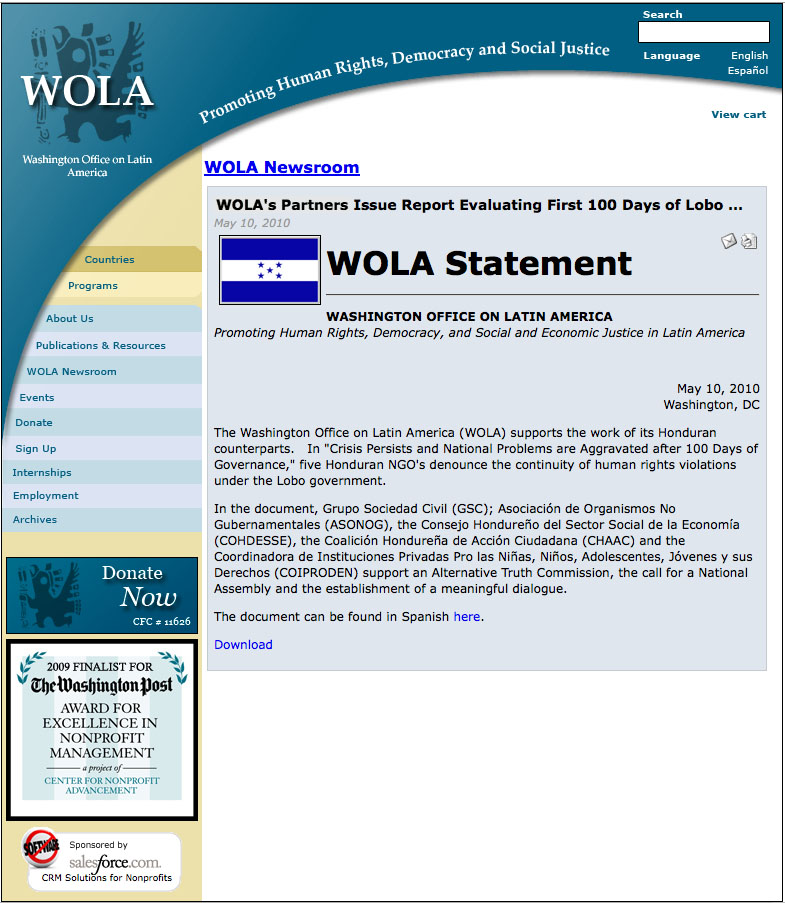
WOLA almost looked like it was turning a new leaf with its blog note a few days ago about a report from its "partners," a short list of NGOs, in which it appeared to link Lobo's government with ongoing human rights violations, and support the call for the Alternative Truth Commission and for a National Assembly (nothing about constituent or constitutional, but I was ready to give them the benefit of the doubt). This move away from promoting increased funding for death squads and toward acknowledging the roots of human rights violations was a welcome shift. In its May 10th post (see screen shots below), WOLA stated:

WOLA's Partners Issue Report Evaluating First 100 Days of Lobo ...
The Washington Office on Latin America (WOLA) supports the work of its Honduran counterparts. In "Crisis Persists and National Problems are Aggravated after 100 Days of Governance," five Honduran NGO's denounce the continuity of human rights violations under the Lobo government. In the document, Grupo Sociedad Civil (GSC); Asociación de Organismos No Gubernamentales (ASONOG), the Consejo Hondureño del Sector Social de la Economía (COHDESSE), the Coalición Hondureña de Acción Ciudadana (CHAAC) and the Coordinadora de Instituciones Privadas Pro las Niñas, Niños, Adolescentes, Jóvenes y sus Derechos (COIPRODEN) support an Alternative Truth Commission, the call for a National Assembly and the establishment of a meaningful dialogue. The document can be found in Spanish here. [note- I've changed the link to a copy of the document on my own site to ensure it remains there]

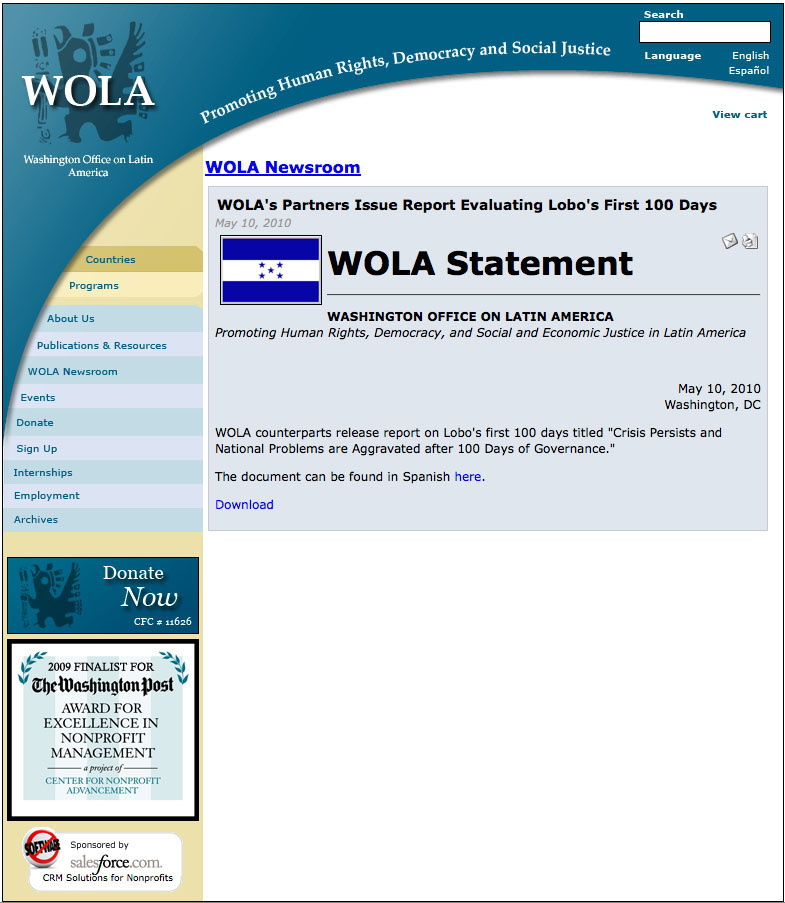
Then sometime last night or this morning, the text changed. The new statement, which was pre-dated to the 10th and can be found (until and unless it changes again) here, reads merely:

WOLA's Partners Issue Report Evaluating Lobo's First 100 Days
WOLA counterparts release report on Lobo's first 100 days titled "Crisis Persists and National Problems are Aggravated after 100 Days of Governance." The document can be found in Spanish here.

Click on images for larger versions:

Fuente: quotha.net/node/939


A wolf with no direction, a government with no compass

In this misgovernment, the violence of organized crime has taken over the tiller of the nation.

by Ismael Moreno
translation by María Soledad Cervantes Ramírez and Adrienne Pine

Honduras is still wounded by the dynamics unchained by the coup d'état. Wanting to come out well with everyone, Pepe Lobo organized a cabinet that is a Tower of Babel. Of the government it is only known that Lobo decides nothing and everybody else tends to their own business to their personal benefit, without there being a credible and consensual authority. In this misgovernment, it is the violence of organized crime which has taken the tiller of the nation in their hands.

The phantom of the coup overshadows all Honduran political realms. Deputy Wenceslao Lara, of the pro-coup Liberal Party, impudently stated before Congress: "We Liberals proposed a candidate who the Honduran people elected as President of the Republic. That Liberal (Zelaya) failed us, and we [acting] responsibly removed him and put another one in his place. Now it falls to the Nationalists to be equally responsible toward the nation, just as we were."

LOBO AND MICHELETTI:
SO ALIKE

Who decides in Honduras since January 27? What remains of that man who in 2004 and 2005 used to raise his fist as the symbol of firm resolve before crime, who appeared as a man of adamant convictions, who is the head of the Executive power today? A weakling. Porfirio Lobo Sosa is an irresolute, feeble mini-president ["presidentillo"] with an anxious smile and a tottering speech, who says no to what he should say yes and says yes to everyone who seeks him out to take advantage of his indecisiveness.

No wonder. Porfirio Lobo climbed onto the most unstable presidential chair in national history, an action to be expected only from a most ambitious person, as he is, certainly with exaggerated similarities with that other man who mounted the Presidency on June 28.

These two characters of the Honduran political landscape, Lobo and Micheletti, resemble each other in so many ways, save maybe in their hair and skin color and their party banners's political color. Both strove eagerly, unto delirium, for the prized presidential fruit whatever the cost. Both, faithful Roman-Catholic, fanatical followers of Cardinals. Both, experts in uttering the clumsiest statements. Both subservient to olive-green uniforms, especially to the watchword of all that is heralded and stated by the voice from Washington. Both adept at choosing the lowest sort of people in Honduran political and business class elites as their entourage; and both driving the State adrift, with no precise agendas or courses, full of fine jingoist statements and, at the end of the day, both trapped in the devalued hubris of being presidents without being statesmen, without heading a State, both experts in only ruining the country.

HOMICIDES AND RAPES

"Nobody knows who really is in command and making decisions in the country”. This is a key phrase that defines Honduras’s present juncture since January 27. Nobody knows who, but one clearly identifies the what: violence and insecurity. On some days 19 homicides have been counted. Mass murders are now completely normal daily fare. Five journalists and several anti-coup leaders have been assassinated in barely two months.

Rape has become a weapon to terrorize and demobilize organized political resistance. A young woman in the resistance north of Honduras, raped in August by four fully identified policemen who still keep their enforcement posts, was kidnapped last February together with her family, seven men took them to a mountain dress as police, and before the men tied firmly to trees the same woman and her sister in law were raped by each one of the seven police. The one heading them dictated the sentence: “That’s what happens to you for going and denouncing us. And the third time we will do the same to you again and will kill you.” I found this event, painstakingly documented in the State Department offices in Washington, in the hands of the official responsible of human rights for Central America.

Such an egregious violation of human rights was confirmed to me by that official on March 4, the eve of a meeting to be held by Secretary of State Hillary Clinton with Central American presidents. Although she was aware of the event, Clinton never blinked in announcing her government’s decision to reestablish U.S.’s aid to the Honduran regime. Moreover, she demanded from governments in the continent the recognizance of Lobo’s administration “because he has taken the adequate steps toward the restoration of democracy.”

DEAF WASHINGTON

As I talked with the human-rights official in the State Department I ascertained that nothing can be done to attain a change of position in U.S. policies. Their perceptions are immovable, like the Vatican’s clinging to defend the indefensible even when all available information belies them.

Even while gathering information on the brutal rapes of Honduran women, gringo officials made their position clear: The United States government is committed to this Honduran "democracy" and this commitment includes supporting the military and the police. "We cannot aid democracy from the outside," Craig Kelly told us. "Only from within the army and the police will we be able to achieve change."

To our question on how he explained the support to police while being aware of the rapes, he responded without blinking an eye, "Nobody can be sure they were policemen. They could as well be criminals dressed as police to commit their felonies." Other queries were useless. The State Department is resolved to strengthen the criminals who in these sad coup and post-coup times, dress themselves as law-enforcement agents…

EVERYBODY KNOWS

Logics are quite well established in the country. While the various sectors opposing the coup are still persecuted, threatened, murdered, and subject to a fierce propaganda campaign to make them appear as the actors of violence in the country, the international community inexorably advances in the process of acknowledgment of the regime even as they know they are recognizing a government with the most miniscule internal legitimacy.

The above is known by European Union nations, which have decided to play in the muddy waters of ambiguities. They know that in supporting the government they are giving a sign of approval to the repressive policies initiated by the government, especially from within the Ministry of Security headed by ill-tempered Óscar Álvarez. Álvarez understands that national crises are resolved by annihilating the opponents, whether they are street felons or Resistance leaders.

Healing themselves before the illness strikes, European ambassadors have decided to implement a program of protection for human-rights defenders. The international community have consented to recognize a government they deliberately identify as a violator of human rights in a continuous line with the coup d’état. They will not state it clearly -that is what diplomacy with all its sophisms serves for-, however they take cover by creating some mechanisms to protect potential victims of the repressive policies of the regime they have decided to incorporate into the payroll of democratic-regime countries.

THE COUP,
ILLEGAL AND UNNECESSARY

The international community have known how to go about mending fences with Honduras; however they do not seem to completely understand how to face a conflict that has remained rooted in the nation’s internal dynamics.

In wanting to confront a Latin American geopolitical conflict, the coup promoters awakened internal dynamics that were latent but not active. Through the ensuing months, the coup started gradually uncovering actors and interests that are beyond the Honduran borders. Once more, it fell on Honduras to play a subordinate role in the continent’s geopolitics.

The coup d’état was not only a violent, illegal act, but also an unnecessary internal political act. If only internal factors had come into play, the coup would have never taken place. There was no need for any coup, inasmuch as the sectors that internally realized the coup held optimal control of all the factors which made Mel Zelaya’s political proposals’s success politically non-viable.

It begs remembering that during the first six months of the year of the coup there was an escalation against Zelaya regarding the election of public officials. January 2009 saw the election to the Supreme Court of fifteen justices, all of them opposed to Zelaya’s team’s policies. In February, Honduran high-born elites approved the election of the Republic’s Attorney General. The previous year ferocious detractor of Zelaya’s policies Ramón Custodio had gained the same approval to get reelected as National Human Rights Commissioner. In April the Liberal Party called a National Convention to elect the new management of the party’s Central Executive Council. The electors carried one single watchword that was fulfilled regardless: remove all Zelaya’s loyals from the party’s directorate. Without warning, Patricia Rodas was suspended as president of the party; in her place, conventioneers elected no more and no less than the great loser of November 2008 primary elections: Roberto Micheletti.

Having been down on the canvass and already buried politically, Micheletti reemerged from that Liberal Convention with astonishing energy. The media replaced him on the first page from where he had disappeared in the previous months. Of the 128 deputies in the National Congress, a third was against Zelaya’s team’s policies. Given those circumstances, the Fourth Ballot Box Zelaya proposed for the elections of November 2009’s last Sunday could not succeed because the Honduran elites had totally armor-plated the whole body of State institutions.

THE GEOPOLITICAL REASONS OF THE COUP

Why then the coup d’état? Because the Honduran actors materialized a plan behind which many international actors were hidden. In the weeks prior to the coup, top representatives of the continent’s ultra-right entities like UnoAmérica spoke out to note that a frontal battle would be waged in Honduras to save the country from Hugo Chávez’s communism.

In early March 2010 the same top representatives returned to the country to assert that a battle had been won in Honduras, however consolidation was needed to continue to fight until the enemy of the continental freedoms was buried. They likewise warned that the enemies of democracy were still active and present in Sao Paulo’s Forum and that from there decisions were taken to recover the ground they had lost in Honduras. One of them [they said] was to inflame internal strife just as it happened in the Aguán region, where peasant groups staged confrontations and, in their zeal to create disorder, sought to seize the lands legally owned by the prosperous and productive businessman Miguel Facussé Barjum. So was stated and published by the media which justified and endorsed the coup d’état.

Honduras has been the excuse in a continental context of geopolitical confrontation advanced by ultra-right sectors fed by multinational monopolies that ideologically also find nourishment in the Neo-Conservative religious discourse both of Catholic and Protestant elites which increasingly dominates Honduras.

THE ROOTS OF THE CONFLICT
IN THE AGUÀN

In the first two months of Pepe Lobo’s administration, the conflict attracting the most attention, along with the escalating criminality and daily assassinations, is the agrarian one latent in the region of Aguán on the Honduran Atlantic coast.

The participants in this conflict are the same who have battled each other in the last three decades. At the forefront appears Miguel Facussé, the most emblematic businessman in the nation, of Arab ancestry to the core, who successfully encroached upon the State dynamics since the 1970s, when during one of so many military regimes he got to deviate to his personal treasury the millionaire funds earmarked for the National Investments Corporation (CONADI), a State institution created to foment industry in the country, of which he was the Executive Director.

Early in the 1990s, in Rafael Leonardo Callejas’ regime, Facussé lobbied for the Congress to pass the Agrarian Sector Modernization Law. In practice that meant, among many other advantages for private business, that the land destined for agrarian reform could be bought by private parties, as well as the opening to private business of legal opportunities to propose to the peasant communities, the beneficiaries of that reform -approved in the early 1970s- to participate in so-called “co-investment programs”: the peasants provided the land and the labor, impresarios provided technology and money, and, theoretically, the benefits were shared among the co-investors. In effect, however, this law conspired to leave the land and the peasants’ own lives at the mercy of exporting agribusiness’ workings. Upon approval of this legal tool, Miguel Facussé devoted himself to “persuade” cooperativist leaders and members –starting with the most successful ones in the production of African palm in the Aguán region- to sell their lands and assets, a goal he achieved in barely two years of ferocious media campaigns which first praised the benefits of co-investment, then promoted the qualities of private enterprise and claimed that the latter was willing to “sweat it out for Honduras”, appropriating the official slogan of the early 1990s with which adjustments to the economy and the opening of customs to the entry of capital for agribusiness in rural areas and the maquila industry in some urban centers, particularly in the Valley of Sula, were furiously pushed through.

LOBO IN HIS LABYRINTH

Two decades later, the cloud of dirt that Facussé raised with the Honduran State and a fistful of corrupt peasant leaders as accomplices, has turned into a real cesspool on which the nation’s attention is focused. It is this area which begins to express the highly conflicting nature, and the moving sands of the country where Pepe Lobo decided to continue to manage an untenable crisis, already made more acute by the coup.

In just the first two months of Lobo's administration, at least 13 persons have been killed in this agrarian conflict. The government decided to appoint a task force to implement a proposal leading to the resolution of this conflict, scarcely the tip of an iceberg against which any proposal or policy of a government crashes --a government trapped in a veritable muddied labyrinth.

Now Miguel Facussé has in motion a propaganda campaign whereby he accuses peasants of promoting disorder and violence in the region and attacking the institutional legitimacy of the rule of law which guarantees private property. He accuses the Resistance, especially those Jesuits working in the area and their “theology of violence” of inflaming the conflict in order to destabilize the country.

There are however serious voices with creditable information who no one could accuse of sympathizing with the Resistance; voices closely linked to the business elites, that maintain that current conflicts in the Aguán are being promoted by Facussé himself. He, at 84, personally appeared in the area haranguing mobs who he himself had paid to concentrate at the National Congress to demand respect for their lands. By acting thus he seized the disorder and the absence of a compass in the country and the State to obtain advantages, as he has had the ability to do all along during his business life.

FACUSSÉ IN HIS EMPIRE

This hypothesis seems to be gaining strength to the degree in which the proposal of the state commission set up to solve the conflict is advanced. The proposal would mean for Facussé the following achievements: that the State buys from him at least 3 thousand hectares with all their improvements, the African palm crops, lands which the State would deliver immediately to the peasant groups. It is a purchase that equals around 50 million dollars. Of the purchased lands each family would receive two hectares, one free for whatever the family wishes to grow, and the other sowed with African palm; in this way the peasants become tied up permanently to Facussé capital, since the marketing of African palm product is absolutely under the control of this successful, parasitical Arab-Honduran businessman.

Due to the conflicts that production generated, Facussé would be exempt from honoring his debts to Honduran banks. Finally, before society, and by virtue of his expertise in handling the most influential media in the country, whose owners or managers are often his relatives, the octogenarian businessman would be characterized as benefactor of the poor, the generous victim of peasants’ threats.

LOBO IN HIS TOWER OF BABEL

Two months after taking office, Pepe Lobo’s government still lacks the capability to define a mission or assuming an identity of its own. Most of its energies have been invested in issuing several calls for help so as to achieve the recognition of international community. First, by composing a cabinet that made him seem the head of a government of national unity and reconciliation. Second, by forming a Truth Commission to make believe that it complies with the accords that put an end to the de facto regime and comes clean from its dynamics of impunity and imposition. Such a Commission has no internal credibility and fails to show an interest in investigating the figures of Honduran politics and big business. Nor has it an interest in stating anything other than what becomes the regime.

And third: doing everything within its reach to best please everybody, it formed, with human-right defenders, a Presidential Commission of Human Rights. With the Catholic and Christian Evangelical hierarchies, it founded another, Human Affairs Commission; and with all the streams in trade unions and political parties it goes on creating Presidential Commissions for any other public matter.

He took pains to appease the Resistance by handing the Ministry of the National Agrarian Institute (INA)—the most inefficient of them all, with barely the budget to pay for bureaucrats and gas—to the president of the leftist Democratic Unification Party, César Ham, the most controversial figure among the sectors opposing the coup, linked with famous and blatant cases of corruption and the source of permanent internal conflicts within the always fragile traditional Honduran left. He wanted to stay on the good side of the powerful teachers’ unions by naming the polemical teachers union leader Ventura, National Party activist, as Minister of Education. He also named as Minister of Labor a man who in his day was a campesino leader, but who for a long time has been closely identified with the most conservative swindlers of the political class.

Wanting to appease all the sectors, Pepe Lobo organized a governmental cabinet that is a Tower of Babel. Each person is doing their own thing, each person speaks their own language, and each one seeks to climb over their colleagues to reach the heights of power.

Two months have been sufficient to leave us facing a public administration that is swimming in a sea of ingovernability, in which all we know is that there are many decision makers, but there are no lines pointing toward a credible and consensus-based authority. In this sea, it is violence that has taken over the helm of the country. And since there are regional spaces for control, it is crime that governs and decides. Honduras is today a territory divided by violence and the diverse institutions of the State end up being subordinated not to centralized authorities in the capital, but to the underground decisions of each one of its parcels, zones or regions in which sovereignty over our resources is administered through violence.

The proposal of the government headed by Porfirio Lobo is nothing more than the continuation of the proposal of the business and political elites who sought to truncate the struggle of Zelaya’s team. An elitist project of this scope, instead of ending the inequity and conflicts that have been accumulating in the country, promise to sink them even further. Diverse sectors of society are in agreement about reiterating the need for a New Social Pact or strategic plan of struggle, as some organized sectors of the popular Honduran Resistance prefer to call it. This plan would need at least three components. The first would be to define content which could be situated, broadly speaking, in three blocs.

First bloc: Demands redefining natural resources, land and the environment. This has to do with what is generically called the fight for national sovereignty. If sovereignty is the control and decision of the State and the citizenry over its patrimony, it is very difficult to speak of sovereignty while trees, rivers, water, the environment and the land are in so few hands. Sovereignty is doubtless the greatest deficit that the country has. Sovereignty is not a slogan. An agrarian reform that responsibly tackles land ownership, to prevent a handful of businessmen from ending up with the most fertile Honduran valleys and subordinating the diet and the very lives of the peasant population to the interests of the multinational agricultural exporters, is a key objective in order to prevent the Honduran territory from turning into a time bomb, a permanent source of instability. We can say the same for the forests, the water, energy, and mining. It pertains to all our natural resources, including the possible existence of oil in the lowlands and coastal regions of the Atlantic.

Second bloc: Social demands: education, health, housing, salaries, respect for ethnic groups and sexual minorities. Respect for and promotion of social organization and mobilization. Linking social demands with demands for sovereignty and natural resources is strategic for guaranteeing the participation of all sectors of society, without allowing elite sectors to confuse their demands with the national demands, which is what happens with the business associations, or –in a different sense- in the teachers unions.

THE CALL FOR A CONSTITUENT ASSEMBLY

Third bloc: political-juridical-institutional demands, that have to do with the transformations that are needed by the Honduran State in order to advance what the different sectors that make up the Resistance refer to as “the refounding of Honduras.” Here is situated the demand for a National Constituent Assembly, the motive for which Honduran elites carried out the coup d’etat.

A Constituent Assembly is currently the most important political demand coming from the heart of the organizations that make up the National People’s Resistance Front (FNRP). Despite the significance of this demand, which many still associate with the leadership of Manuel Zelaya, very little has happened to transform it from theory into practice.

In mid-March at the initiative of the Civil Council of Popular and Indigenous Organizations of Honduras (COPINH) and in conjunction with the FNRP, a large representative assembly was convened to create a model for a National Constituent Assembly. There, the first bloc of demands were discussed. Despite the richness of assemblies like this one, the simulation of popular participation did not go beyond an assembly of sectors that are closely related in terms of how they see and understand the country, excluding others from the debate.

And so, the demand of these popular sectors for an inclusive society ends up, in fact, in a newly exclusive proposal because in this “Constituent Assembly experiment” only those people who are accredited as militant opponents of the coup d’etat with a proven allegiance to the country’s leftist tradition can be accepted.

NOT JUST THE CHOIR

A new social pact cannot merely be a matter of preaching to the choir taking into account only the perspective of the popular sectors of the left. There should be openness and debate among all the diverse sectors of Honduran society. A Constituent Assembly of this type, without a particular content, can be a double-edged sword. It contributes to awakening the consciousness of struggle among the sectors within the Resistance, but it is an instrument that can be easily captured by the elites, as they have already done with all the political-institutional reforms carried out in the country in the past two decades.

A prominent Honduran politician has already announced this: “We are moving toward a Constituent Assembly. The one we did not accept was that of Mel Zelaya, because we are not interested in having anything to do with Hugo Chávez. But once this Mel fever is over, we ourselves are going to carry it forward, through Pepe Lobo. And we will write a Constitution.

A DEBATE
BETWEEN THREE POSITIONS

The second component of a new Social Pact would consist in defining the social and political subject. The debate here would take shape in relation to the political parties and social movements, the similarities and differences between the two, and the identity that the National People’s Resistance Front should assume. Currently, the debate is going through the process of establishing the relationships and differences among three positions.

First position: This is maintained by the sector of the Resistance linked with the Liberals in resistance to the coup, most of them followers of Manuel Zelaya, although between them there can be found many secondary differences.

A Liberal leader among ideologues, put it this way in one of the assemblies convened by the FNRP:

The Front can take three possible routes. The first is armed struggle. We reject this because it will not give results and because at the first sign of violence the war machinery that keeps the oligarchy in power will annihilate us. The second is the route of becoming a political party. This is a real possibility, but we know that the antidemocratic nature of the Electoral and Political Organizations Law will block us every step of the way. And the third is for the FNRP to become an internal current of the Liberal Party to help retrieve that party from the grip that the oligarchy currently maintains on it, so as to successfully advance to elections and retake the transformations that were cut off by the coup d’etat. We, the Liberals in resistance, propose that third route.”

To turn the FNRP into an internal current of the Liberal Party, or to associate with one of the three small parties is, according to an important sector of the Resistance, one of the political errors to be avoided. The Resistance would end up as a prisoner of the system of political parties that has already collapsed. Such a decision would give oxygen to a brain-dead patient with no hopes of coming back to life.

A NEW PARTY
OR A SOCIAL MOVEMENT?
Second position: This position proposes to turn the FNRP into a new political party from which to fight for the changes contained in the first component of the New Social Pact. Those who maintain this position are those who believe we are in facing the urgent, unpostponable challenge to fight for political power and that, with armed struggle out of the question, this can only be achieved through elections. For that it is necessary to have a political party that successfully competes with the other five parties that are already on an irreversible road to ruin.

Others believe that turning the FNRP into a political party would mean shrinking the strength of the Resistance, so broad and sustained by so many grassroots efforts, to a strict electoral fight. In the end this would mean the Liberals in resistance and others who resist while affiliated to other parties would return to their party structures, converting the new political party into a proposal the size of the Christian Democratic Party, or the Democratic Unification Party, or the Party of Innovation and Unity, which together never achieve a vote of more than 6% of the electorate.

Third position: Argues that the FNRP should maintain a permanent identity as a broad front that, as a social movement, channels the diverse demands of the popular and social sectors of the whole country, of the unions as well as of the local, regional and district-wide community organizations of the country. There is a tendency that a broad sector of the FNRP has staked out, affirming that the front should maintain its identity through two modes of struggle in the current period.

The first is that of the keeping on the pressure so as to weaken, denounce, and unmask the current political regime as a faithful continuation of the coup d’etat, until it is obligated to convene a National Constituent Assembly. The second, is to go forward in defining a proposal for independent candidacies that could turn into a successful strategy for the next general elections.

The third component of a new Social Pact is to clarify the participation in the political electoral processes. Once the identity of the FNRP is defined, within the framework of hte three positions laid out here, the fight to democratize the mechanisms of popular participation should be assured so that the electoral process stops being expressions that, following legal procedures, legitimate the appropriation of the State by the tiny elite that was behind the coup d’etat.

IN HONDURAS
THERE IS NO STATE OF LAW

Rule of Law cannot exist without democracy and without respect for and protection of human rights. In the case of Honduras we cannot speak of a deficient State of Law, but rather of the absence of a State of Law. In Honduras the problem is not so much that political or business groups violate the Rule of Law but that, lacking the existence of a Rule of Law, they manipulate that concept to make it look like they are following the laws and defending democracy, when what they are actually doing is imposing the principle of Might is Right, and violating with full force the society’s human rights.

CORRESPONDENT OF ENVÍO IN HONDURAS.

Fuente: quotha.net/node/940


Professionalizing the Honduran Police: Advice from Germany

By RNS

An article in La Tribuna today reports that Cristian Luth, the Director for Central America of the the Friedrich Naumann Foundation, says that the Foundation will advise the National Police in Honduras "to guarantee the professional development of their employees":
"The Friedrich Naumann Foundation, at the request of [Director of the National Police] Jose Luis Muñoz Licona, will work with the National Police to first perform a structural analysis, and then an analysis over the work of this important institution in conjunction with two German Police colonels. The result of this analysis will serve as a guide to this institution, and the Honduran government, to guarantee the high professional level of the Honduran Police."

Then-President Carlos Roberto Reina of the Liberal Party reportedly used the Foundation in 1996 and 1997 to advise on the separation of the National Police force from the Armed Forces by coordinating a dialogue between civilian and military representatives on the need of a democracy for independent institutions.

Luth said, "this also was the theme of the last year when we supported President Roberto Micheletti."

What is the Naumann Foundation, and what expertise does it have in reorganizing police forces in Latin America?

It describes itself as "a foundation for liberal politics," based on the ideas of German protestant theologian Friedrich Naumann, who believed that a functioning democracy needs politically informed and educated citizens. The Naumann Foundation intends to promote civic education, political dialogues, and political counseling. It is affiliated with the German Free Democratic Party (FDP), a Liberal party that is a minor partner with the Christian Democrats and Social Democrats, emphasizing neoliberal economic policies like privatization, deregulation, "reducing bureaucracy", and "reform of collective bargaining". In other words: Republicans.

The values the Friedrich Naumann Foundation espouses are interesting. One goal is that all citizens may freely live in an open society. It supports free markets, and access for all to education, labor, information, markets, and small government.

Curiously, the Foundation emphasizes that it is interested more in the equal application of rules to all rather than justice, because "just results do not exist."

The Friedrich Naumann Foundation has worked with the Liberal Party of Honduras (PLH in Spanish) for some time. Rosalinda Sabillón, the Foundation program director in Honduras bragged shortly before the coup that the Naumann Foundation had a "39 member caucus" in the Honduran Congress.

The Foundation offers seminars and training courses to Liberal Party members, and provides them with access to campaign advisors from the German FDP. President Zelaya had an FDP campaign advisor on his campaign, Peter Schroeder. Schroeder had worked as communications director for the FDP prior to forming his private company to manage political campaigns. The foundation also trained Mary Elizabeth Flores Flake, who Porfirio Lobo Sosa just appointed as ambassador to the UN, former candidate for president Elvin Santos, former Zelaya adviser Yani Rosenthal, Central Bank director under the de facto government Gabriela Nuñez, and the head of the de facto regime, Roberto Micheletti Bain, who in 2008 held meetings with FDP Vice President Werner Hoyer about intensifying the Foundation's activities in Honduras with an eye to the 2008 internal PLH elections.

Via its Central American director Cristian Luth, the Foundation promulgates the idea that Roberto Micheletti Bain "defended the constitution of Honduras against titanic forces", and that Manuel Zelaya was going to introduce "twenty-first century socialism" in Honduras. This was a position it took after Zelaya, formerly a protege, led Honduras in joining the ALBA alliance.

Today, the Naumann Foundation is promoting Elvin Santos as the best hope for re-uniting the Liberal Party, since he continues the ideas of Roberto Micheletti. The foundation regularly place their press releases in El Heraldo and La Tribuna as news stories. Their agenda for Honduras is clear, and adds to the evidence that last year's coup d'Etat, far from being entirely an internal struggle, was supported by global conservative economic, political, religious, and social forces.

Fuente: hondurasculturepolitics.blogspot.com


domingo, 16 de mayo de 2010

Fallece antepasado polítco de Goriletti o entre bananas y primates

Fallece ex presidente de facto de Honduras

Militar y hombre de negocios, López Arellano permaneció postrado los últimos años de su vida a causa de la enfermedad que finalmente acabó con su vida.

El ex presidente de facto de Honduras Oswaldo López Arellano falleció este domingo durante una cirugía. Tenía cáncer de próstata.

Militar y hombre de negocios, López Arellano permaneció postrado los últimos años de su vida a causa de la enfermedad que finalmente acabó con su vida.

López Arellano provenía de una familia pudiente de Honduras. Estudió en la escuela Americana y se graduó como piloto de la Fuerza Aérea de Honduras.

En 1957, la Asamblea Nacional Constituyente elige a Ramón Villeda Morales como presidente de Honduras. Villeda Morales nombra a López Arellano como jefe de las Fuerzas Armadas y le da autonomía militar.

El 3 de octubre de 1963, diez días antes de las elecciones generales, López Arellano encabezó un golpe militar contra Villeda Morales. El candidato que se perfilaba como virtual triunfador de esos comicios era Modesto Rodas Alvarado.

Se sospecha que el mismo Villeda Morales estaba confabulado con López Arellano porque un día antes del golpe mandó desarmar la Guardia Civil que era el brazo armado del presidente.

El golpe de Estado de ese 3 de octubre dejó cerca de tres mil muertos en todo Honduras.

López Arellano asumió el poder como presidente de facto y en 1965 convoca a una Asamblea Nacional Constituyente y legaliza su jefatura para un periodo de seis años, hasta 1971, cuando se celebran las elecciones que dan como vencedor a Ramón Ernesto Cruz.

Cruz comete el error de dejar las Fuerzas Armadas a cargo de López Arellano, quien le da golpe de Estado apenas un año después de asumir la Presidencia.

A partir de ahí comienza un segundo mandato del gobierno populista: López Arellano se identifica con los pobres, entrega tierras a los campesinos y promueve reformas agrarias. En este periodo surge la Suplidora Nacional de Productos Básicos (Banasupro).

Además, creo un gabinete de lujo en el que se integran líderes de la izquierda. Entre sus funcionarios estaban Enrique Aguilar Paz, del Partido Innovación y Unidad (PINU), y Gautama Fonseca, como ministro del Trabajo.

Oswaldo López Arellano fue protagonista de la guerra de 1969, entre Honduras y El Salvador, y del escándalo de corrupción conocido como "Bananagate", y en el que estaba involucrado su ministro de Hacienda Abraham Benaton Ramos.

El soborno millonario de la United Brad Company para que López Arellano redujera algunos impuestos para la exportación de banano propició el golpe militar que le dio en 1975 el general Juan Alberto Melgar.

Fuente: elheraldo.hn


Iglesia Católica Francesa suspende premiación al Cardenal Rodríguez por golpista

image

El prestigio que una vez tuvo el Cardenal Oscar Andrés Rodríguez en el ámbito internacional por ayudar a los países en vías de desarrollo y considerado papable en su momento, ahora se le ve con sumo desprecio por la comunidad internacional, por el hecho de haber avalado el golpe de Estado contra el Presidente Manuel Zelaya, y de ser encubridor de las violaciones a los derechos humanos de los compatriotas que se encuentran en las calles exigiendo el retorno del orden constitucional.

Comunicado de la Embajada de Honduras en Francia

La Embajada de Honduras en Francia tiene el placer de informar que la entrega de las insignias de Doctor Honoris Causa al cardenal golpista Óscar Andrés Rodríguez Maradiaga, previsto para el 24 de noviembre en el Instituto Católico de París, ha sido anulado.

Esta decisión es debida a las presiones fuertes ejercidas por diferentes sectores a nivel nacional e internacional, oponiéndose a la entrega de este reconocimiento a uno de los autores principales del golpe de Estado en Honduras, clasificado como tal en el informe oficial del golpe de Estado elaborado por el gobierno constitucional del Presidente Manuel Zelaya, que también ha sido acusado por algunas organizaciones hondureñas, de delitos de corrupción y de malversación de fondos públicos.

La noticia escandalosa de la preparación de esta ceremonia ha sido denunciada inmediatamente por el gobierno legítimo de Honduras, del que las autoridades solicitaron cerca del gobierno de la República francesa, de no permitirles la entrada sobre el territorio francés del Cardenal Rodríguez ni a otros autores del golpe de Estado.

Les expresamos nuestro agradecimiento profundo a todas las personas que participaron en esta lucha que tuvo por el resultado una victoria inestimable para el pueblo hondureño y para toda humanidad.

Fuente: ellibertador.hn


Cardinale golpista in visita a Roma

Il 28 maggio, a Roma sará presente questo triste personaggio, gran maestro nel coniugare l'essere e l'avere, la fede con le grandi proprietà, la teologia con il golpismo, la religione con la politica illegale. Al gregge ha sempre preferito l'Opus Dei e le élites dell'Honduras.

Il Cardenal Rodriguez Madariaga, meglio conosciuto come cardinal Golpe, teorico ed apologeta del golpe messo a segno contro il legittimo Presidente Zelaya, parteciperà alla presentazione del libro di G. Crea "Agio e disagio nel servizio pastorale", presso le Suore Guanelliane, in Piaza San Pancrazio 9 ROMA.


E' l'occasione per manifestare al famigerato gerarca che nasconde sotto l'uniforme religiosa una militante attività politica antidemocratica di promotore del golpismo, Costui, pochi mesi addietro, venne invitato in Francia da una università cattolica per ritirare un premio (sic). Le proteste sorte tra i credenti e in vari settori della società civile portarono alla sospensione di quell'evento.

(vedi comunicato dell’ambasciata francese in Honduras http://www.ellibertador.hn/Nacional/3493.html)


Fuente: selvasorg.blogspot.com


La Unión Europea y las empresas transnacionales en América Latina


Fuente: www.albedrio.org - www.enlazandoalternativas.org


ALERTA Radios Comunitarias de Honduras

Constituyente-si.jpg


COMUNICADO PÚBLICO

Nosotros y nosotras integrantes de la Red Mesoamericana de Radios Comunitarias – HONDURAS, reunidos en la Esperanza, Intibucá a 8 de mayo de 2010, frente a la grave situación de agresiones a medios de comunicación alternativos y comunitarios que se vive en el país por...


La Radio La Voz de Zacate Grande, ubicada en la tierra recuperada de la comunidad de Puerto Grande, sigue transmitiendo en un contexto de represión sistemática por parte del oligarca Facussé, desde que fue inaugurada el pasado 14 de abril. A través de sus títeres como ser la Fiscalía acusaron de usurpación de tierra y defraudación fiscal a 8 dirigentes del Movimiento de Recuperación y Titulación de Tierra de Zacate Grande. El día miércoles 5 de mayo tuvo lugar la primera audiencia de presentación voluntaria de los acusados en el Juzgado de Letras de Amapala donde se pusieron las medidas cautelares (ir a firmar cada 15 días en el Juzgado y no salir del país, entre otras cosas) a todos.

Alertamos a la sociedad civil nacional e internacional de que estén al pendiente para la próxima audiencia que será en la mañana del 27 de mayo 2010. El temor es que en esta próxima audiencia se tomen medidas mas drásticas en contra de la radio, como ser la demolición de la casita y el secuestro de los aparatos, así como pide la Fiscalía, o acciones en contra de los comunicadores y las comunicadoras. No se descarta la posibilidad de, al no poder tomar acciones en contra de la radio legalmente, Facussé proceda a atentar por sus propios medios contra sus instalaciones y contra el personal que trabaja voluntariamente en ellas.

Responsabilizamos a Miguel Facussé y sus guardias privadas así como a las autoridades que lo respaldan en caso de cualquier agresión a la radio y a los comunicadores y comunicadoras.

Al otro extremo del país en el departamento de Colon, la comunidad Guadalupe Carney, ubicada desde mayo del año 2000 en las tierras que antes ocupó el Centro de Entrenamiento Militar, CREM, se encuentra militarizada desde el 11 de abril. Esta incursión de elementos del Ejército en la comunidad se da en el marco de la Operación Trueno que ha movilizado miles de militares y policías en la zona del Bajo Aguan. El Movimiento Campesino del Aguán, en el que se aglutinan las diferentes organizaciones que se encuentran en la comunidad, ha emitido recientemente un comunicado en el que denuncia las agresiones y hostigamientos que sufren desde que el Ejército entró a la comunidad con el pretexto de brigadas médicas.

Dada esta grave situación, tememos como Red acciones contra nuestra radio hermana, Radio Orquídia, que se encuentra ubicada en la Guadalupe Carney.

En el contexto de agresiones a radios comunitarias que se vive en el país (primero la quema de Radio Faluma Bimetu en Triunfo de la Cruz y después las amenazas a Radio La Voz de Zacate Grande), queremos alertar a la comunidad nacional e internacional sobre cualquier acción contra la integridad de las personas que trabajan en Radio Orquídia o de sus instalaciones por parte de los militares que han invadido la comunidad.

Como Red Mesoamericana de Radios Comunitarias responderemos de manera conjunta y unitaria, tomando las acciones necesarias, frente a cualquier agresión hacia las instalaciones o los comunicadores y comunicadoras que trabajan de manera voluntaria en nuestras radios hermanas.

Con esto queremos reafirmar el compromiso que como comunicadores y comunicadoras tenemos con nuestros pueblos, y decir una vez más que, pese a las amenazas y hostigamientos, vamos a seguir al aire.

LOS MEDIOS SON DEL PUEBLO, EL PUEBLO HACE LOS MEDIOS

Red Mesoamericana de Radios Comunitarias – HONDURAS

La Esperanza, Intibucá 8 de Mayo de 2010

Radio La Voz Lenca, La Esperanza, Intibucá

Radio Guarajambala, San Francisco, Lempira

Radio La Voz de Zacate Grande, Amapala, Valle

Radio Faluma Bimetu, Triunfo de la Cruz, Atlántida

Radio Durugubuti Beibei, San Juan Tela, Atlántida

Radio Sugua, Sambo Creek, Atlántida

Radio Orquídia, Guadalupe Carney, Colón


Lobo Sosa juega ruleta rusa; la pistola es del FMI

Ricardo Salgado

El régimen golpista de Porfirio Lobo Sosa se encuentra en un callejón sin salida financiero que ya comienza a tocar las campanas en su propio partido político. El alcalde Ricardo Álvarez, está hoy agobiado por una administración municipal gigantesca, ineficiente, corrupta y costosa; su reacción ha sido presionar con lo que puede al régimen conducido por su propio partido. Menudo problema, agravado por las declaraciones del Secretario de Finanzas de turno, William Chong que afirmó recientemente que muchas secretarías de estado ya habían consumido el 95% de su presupuesto para el 2010, y ¡estamos a mediados de mayo!

Mientras tanto, todos los genios al servicio del golpismo comienzan a elucubrar sobre las posibles soluciones al problema, sin recurrir a la molesta salida que implica “complacer” a la comunidad internacional. Muchos de ellos escupen literalmente palabras y consignas de dignidad nacional; patrioterismo que no manifestaron cuando asesinaron, secuestraron y nos usaron como base para masacrar a nuestros hermanos centroamericanos.

Como era lógico esperar, muchos piensan que el camino es librar una batalla interna contra las conquistas de los trabajadores. Manifiestan con pasmoso cinismo que el problema del salario mínimo es que afecta al estatuto del docente, y que los maestros no deben ganar más porque no imparten doscientos días de clase al año; número mágico con el que según estos maestros del pensamiento, abriremos las puertas del conocimiento y con ello del desarrollo.

Según estas lenguas y plumas de alquiler afirman, las conquistas laborales son la mayor amenaza a la existencia del Estado hondureño; algunos virtuosos mercenarios de la palabra, ya mencionaron la palabra “fallido” al referirse al Estado nacional. Siguiendo la inferencia de los apologistas del golpe y el neoliberalismo representado por ellos y sus lenguas esclavas, al bajar sus costos el gobierno, existirá felicidad, el Shangri Lá para la oligarquía local y sus sirvientes más cercanos.

No parecen entender que esa solución es básicamente imaginaria, debido al parasitismo que vive la gran empresa respecto al Estado; sin negocios con el gobierno, no hay ganancias exorbitantes. El único cliente que da para todos los gustos, y que incluso pierde los casos judiciales frente a las empresas privadas con gusto y con la complicidad de los felices defensores del bien común, es el Estado.

Por ejemplo: ¿Quién le va a pagar a las empresas generadoras de energía (antes térmicas ya hora devenidas, golpe-gracias, en ambientalistas productores de energía renovable)?; o, ¿cómo van estos salvadores del progreso hondureño a conseguir el aval para la construcción de las obras que les producirán su felicidad por los siguientes 20 años? Aún tienen la fortuna de que el pueblo no ha comenzado a protestar por las concesiones que se han de otorgar para la construcción de estas represas, que han de privatizar cuencas hidrográficas a lo largo y ancho del país, y a dejar sin acceso al agua a miles y miles de hondureños y hondureñas.

Negocio redondo, el Estado avala, el pueblo paga, y ellos se hacen ricos. Pero sin los primeros dos no hay negocio, eso es lo que no entienden o no dicen los “formadores” de opinión pública en los medios locales. Hay que preguntarnos cuantas veces se va a multiplicar la presencia de gente como Miguel Facussé en conflictos agrarios por tierra y agua en todo el país en los meses que vienen. Pero ni este sujeto, ni ningún otro especulador-explotador, pueden prescindir del Estado, ni de sus finanzas públicas.

La siguiente apuesta va por el camino de la generación de inflación, a través de la producción de circulante sin respaldo (como habría de tener respaldo en las condiciones actuales de Honduras). Por este mecanismo inyectan un flujo que logre aparentar una actividad económica sostenida y responda las exigencias de la deuda interna. Normalmente, este dinero va a pasar por las manos de los trabajadores en forma de salarios, pero no impactará las reservas de los bancos, ni los intereses de las empresas que trabajan en sectores estratégicos como la energía, comunicaciones, infraestructura, etc. Tampoco afecta a aquellos que se dedican a la exportación. Todos respaldan sus operaciones en dólares.

Plan perfecto, se puede dejar que esta inyección de dinero de juguete fluya sin mayor riesgo, para eso, el Fondo Monetario Internacional tiene estrategias que sirven para subsanar los problemas que genera el manejo irresponsable del sistema financiero nacional. Por esa razón, se ocupan dos pasos siguientes: el primero, hacer un ajuste salarial, que hasta puede ser temerario, ¿y porque no?; la maquinita de hacer dinero funciona justo para eso. Claro está, los que prestan su fuerza de trabajo creyendo que son empresarios medios o pequeños se llevan la más fea; a ellos no los favorece el plan, al contrario, los arrincona. El siguiente paso implica necesariamente la devaluación, el deslizamiento de la moneda, hasta el punto en que se pueda compensar tanto el factor inflación como las “perdidas” de “los inversionistas”. ¡Que bella la especulación del capital!.

Pero ¿y esta vía no ha generado intranquilidad ya en otros países?; ¿está la economía hondureña inmunizada contra el efecto helénico?; una sociedad cuasi a la deriva, ¿puede darse el lujo de jugar con esta pira que han escogido como alternativa estos señores?, ¿valdrá la pena llevar al país a un despeñadero seguro, cuando no se hace por ingenuidad o por torpeza, sino por falta de voluntad para resolver la verdadera crisis, de naturaleza política, y surgida entre diferencias irreconciliables de clase?

El desarrollo de estos acontecimientos se da en medio de una tremenda inestabilidad e insatisfacción de los sectores más pobres del país. El problema amenaza con desbordar la capacidad política de los partidos tradicionales. Desde el Frente Nacional de Resistencia Popular se hacen las advertencias oportunas, se plantean los caminos que deben seguirse para alcanzar un nuevo estado Nacional. Señores golpistas, la Asamblea Nacional Constituyente, la refundación de la patria, no es un capricho; es una necesidad de resolución impostergable.

Los cálculos de la clase dominante en términos de dinero han sido malos en estos últimos tiempos, pero sus evaluaciones políticas la están acercando a un punto sin retorno. De hecho, hasta hace poco pudieron incluso abanderar una constituyente dominada por ellos, con alguna posibilidad de éxito para calmar la situación por un par de años más; hoy esa opción ya no existe: o respetan la voluntad de pueblo soberano o se atienen a las consecuencias.

La alternativa política presentada por el presidente Zelaya en Ecuador le da a Lobo Sosa la oportunidad de llevar adelante un proceso histórico, desmantelando el aparato golpista, que más temprano que tarde será destruido en su totalidad, a la vez que se integra un proceso que lleve a una nueva Honduras. Es cierto que es más fácil escribir estas líneas que enjaular de regreso a los gorilas, o adormecer a los rottweiller de Carlos Flores en la Fiscalía, la Corte y el Comisionado de Derechos Humanos, pero hacerlo es un paso obligado si se busca llevar al país por un sendero diferente.

Allanar este camino, considerando la actividad conspirativa permanente que sale de la alcaldía capitalina, para mantener protegidos a todos estos especímenes que tanto luto y dolor nos han traído, luce bastante complicado para el señor Lobo. No hay que olvidar que la junta de comandantes todavía dirige el aparato represivo desde puestos clave del gobierno. Luce mucho más fácil que le pongan el pijama a Lobo los que ahora le ocasionan tantos problemas, frente a la posibilidad de que él consiga el apoyo del congreso de facto.

Esta gente no conoce límites. Si les toca poner a ladrar a los moyolos, o los amarillos que tienen dispuestos en todos los medios de comunicación, justificando una “sucesión constitucional” con un pequeño contingente de bestias dispuestas a darle a quien sea necesario, lo van a hacer, con la diferencia de que a Lobo no lo vamos a respaldar bajo ninguna circunstancia.

Claro está que el pueblo ha de sufrir mucho más debido a esto, pero esta vez no será en vano. La primavera de la que nos habla con hermosas palabras Amaya Armijo, pasa por ese oscuro y frio invierno en que nos tienen, pero deben estar seguros de llegará, cueste lo que cueste, llegará.

Ahora nos toca como pueblo hacerle entender a Lobo Sosa y a todos los demás, que no aceptamos más engaños; que defenderemos las conquistas de los que ya las alcanzaron, y conquistaremos estadios mejores para los que todavía no tienen nada.

Deben entender que no somos más el actor pasivo, inerte, que puede con todo, hoy estamos conscientes de la necesidad de luchar y lo vamos a hacer; estamos decididos a defender lo que históricamente nos pertenece, a defender a los hermanos que ahora son perseguidos políticos por la “justicia” de los cobardes que no enfrentan con honra sus fatales errores, al contrario, tratan de mantener arrinconados hondureños de valor infinitamente mayor que el suyo, utilizando el terror, la amenaza, la intriga y la mentira.

Vivimos en la edad de la oscuridad, el momento de la luz está cerca; y esa proximidad se debe a que marchamos invencibles, hasta la victoria siempre.